Feeds:
Posts
Comments

Archive for June, 2012

June Is For Roses

June is almost behind us now but I couldn’t let it disappear completely without paying homage to the rose – for June is all about elderflowers and roses!

As anyone who has been following this blog for a while knows, I (like many others) am a sucker for roses. There is so much you can do with them at this time of year, for the kitchen, the bathroom or the medicine cabinet, and all will bring that gentle honeyed sweetness into your life, uplifting the spirit and gladdening the heart. In this post I wanted to share some pictures of a few of the roses currently in bloom along with some ideas about how you might want to use them.

Old favourite Margaret Merril has the most perfect blooms and a deliciously delicate scent.

Alex’s Red has suffered a bit with blackspot this year but the blooms are beautifully formed with a gorgeous deep burgundy hue. I have heard that you can treat blackspot with a spray made of a 50/50 mixture of milk and water but I haven’t tried it yet to confirm.

Below is a new addition, Cariad, which I bought last year as a bare root almost purely for the name which means ‘love’ in Welsh. It actually looks quite different from the photo I saw but I like it anyway and it looks lovely with red campion and vervain planted infront.

Scepter’d Isle is an even softer, warmer pink which is very relaxing to look upon. She can go a bit brown in heavy rains but now the weather is a clearer she is in finest of forms.

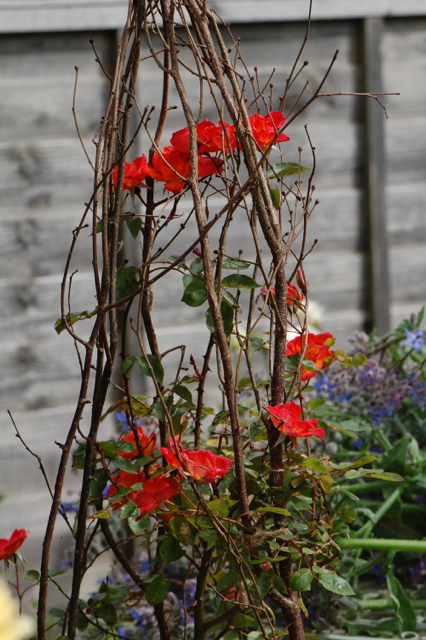
Warm Welcome is a miniature climber that was bred by my uncle. Both he and my great grandfather were rose breeders so I guess some degree of obsession must be in the blood! Both have also written books on the subject. A tipi support of hazel twigs lends this rose a fairytale charm.
Jude the Obscure is one of the most beautifully fragranced of all the roses. At this time of year I can hardly walk down the garden path without stopping to bury my nose in the blooms whilst my husband attempts to hurry me along calling ‘go, go, we’re going to miss the train!’

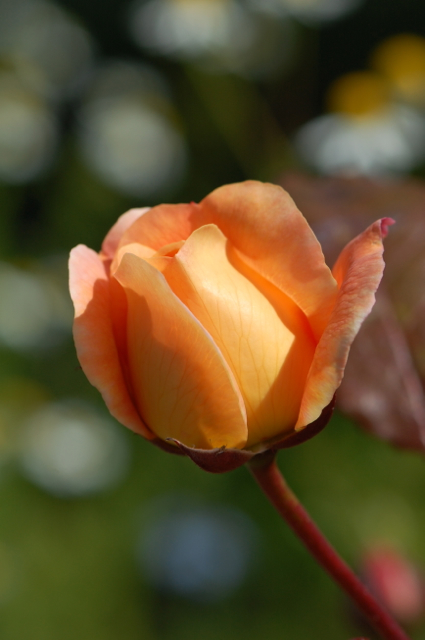
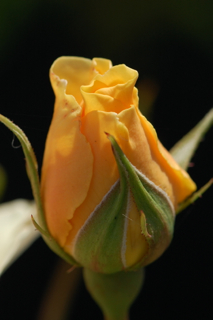
Goldfinch is a lovely small rambler that I bought to grow over the unsightly oil tank situated by our garden gate. The flowers are a soft apricot hue that fades to cream as they age.

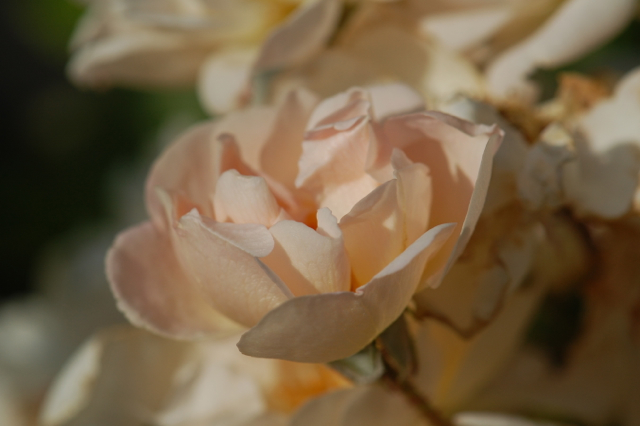
The rose is the plant that is perhaps most closely associated with the heart and this summer I noticed an interesting connection between the two. The petals of the rose open in a spiral looking not dissimilar to the heart muscle itself which recent research has proven is actually one muscular band that pumps and suctions blood by opening in a spiral. You can see a video of this here, be sure to watch right to the end when you see how the heart actually pumps, it is quite amazing to behold and something of a revolution in the study of anatomy. Comparing the two put me in mind of the the doctrine of signatures, the idea that something in a plants aspect gives us clues as to what it can be used for.

_____________________________________________________________________________________
Along with the Apothecaries Rose and the local wild roses, Gertrude Jekyll is the rose I use most for medicine making. I wrote this post last year about using it in tinctures but it also makes the most fantastic infused vinegars, honeys and elixirs. It has a particularly high yield of essential oil so it imparts a beautifully sweet rose flavour to whatever menstruum it is infused in.

To make a rose infused vinegar or honey, all you need do is lightly pack a jar with any highly scented, unsprayed rose petals and cover with your liquid of choice. As the petals are so delicate they give up their flavour easily. If you leave the petals in the honey it can be used almost immediately but if you prefer to strain it then let it infuse for a couple of weeks first. A week is enough time for the vinegar. Remember to cap your vinegars with a plastic rather than metal lid to avoid corrosion.
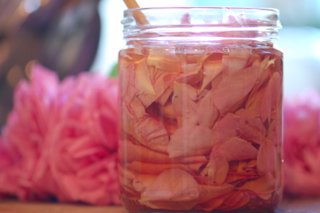
To make a rose elixir you follow the exact same process but fill the jar a third full of honey and two thirds of brandy or vodka to cover the petals. This is a nice mix of the deliciousness of a honey infusion with a stronger alcohol extraction which will result in a more potent medicinal effect. This can be strained after only a day or two as the volatile oils in the plant are easily extracted into the alcohol and the medicine will become more bitter and astringent as time progresses, something that may not be desirable if you want to maximise the flavour of the end product. Rose petals are also delicious in a salad and look beautiful with other edible flowers. Danielle at The Teacup Chronicles recently posted a recipe for a strawberry and rose petal salad which looked delectable.

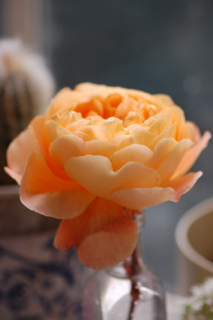
At this time there are so many roses in bloom that I can’t resist picking a few for the kitchen windowsill. Gazing at them and smelling their sweet scent on the air helps to make doing the washing up a far more pleasurable task!

Read Full Post »

Roses, chamomile and nigella.

Borage, valerian and rose.

_______________________________________________________________________________
I just love this time of year when everything in the herb garden is overflowing; with colour, scent, the buzzing of insects and the joy of being, expressed in its fullest.

The intermittent sun and rain have ensured lush growth on everything. Several things have bolted like the lettuces, parsley and this 8 foot monster lovage.

Lovely lovage.

Parsley gone to seed.

However plenty of other things are just opening, the feverfew and vervain included. I adore vervain, Verbena officinalis, it is easy to see why it was considered a sacred herb by the Druids, it has such a magical quality to it.

Feverfew

Vervain

Many herbs are in full bloom and perfect for harvesting now like lavenders, thymes and white horehound.

Thyme

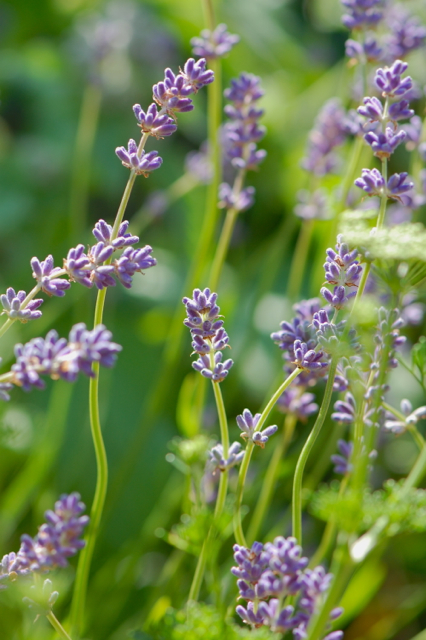
Lavender

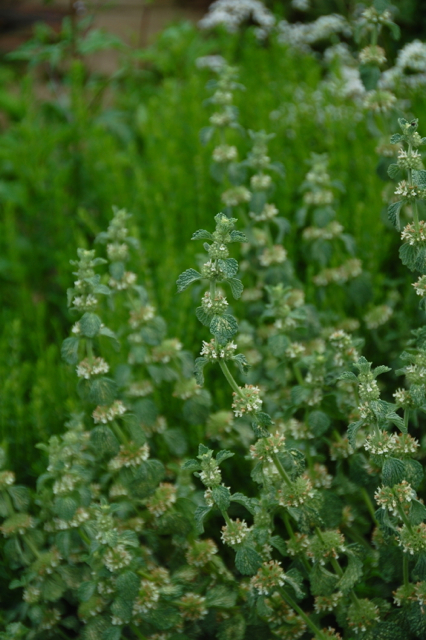
White Horehound

_______________________________________________________________________________

Lavender – Edelweiss

The garden is full of one of my favourite flowers, Nigella, or love-in-a-mist. This year I not only have the usual blue variety but some gorgeous pink ones, Mulberry rose, the seeds for which were sent to me so kindly by Cheryl last year.

One of the real highlights of summer is the vibrant colours, sun-filtered and glowing so that even in my tiny plot there is always something new to marvel at. Yellow loosestrife is a beautiful wildflower but one I grow in pots due to its over zealous nature!
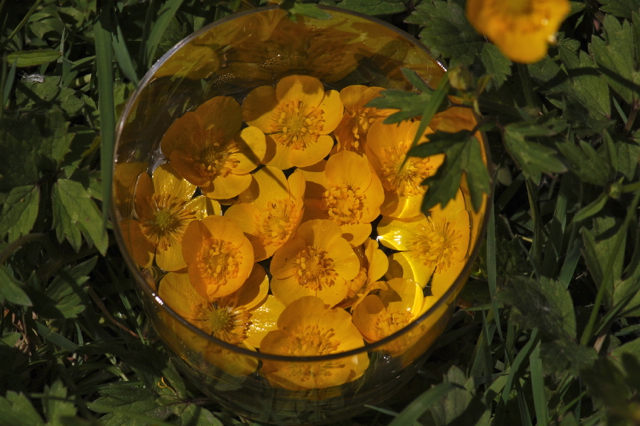
Yellow loosestrife

Rosa ‘Lady Emma Hamilton’

_______________________________________________________________________________

Even simple salad vegetables can be among the highlights of the garden.

Tree spinach

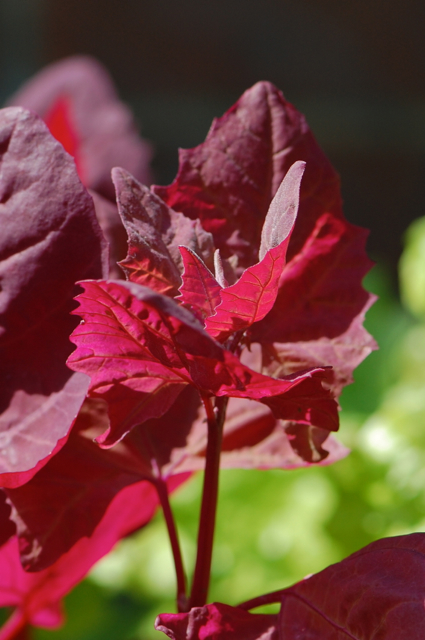
Red orach

_______________________________________________________________________________

These lovely little sea thrifts were given to me by my father who grew them from seed.

What are the highlights of your garden right now?

Read Full Post »

This month’s blog party is hosted by Ali over at Eldrum Musings and is all about sharing aspects of working with herbs that are personal to us. She writes ,”What do you do that makes your herbalism uniquely yours?  This can be an experience, a subject close to your heart, even a herbal ally that you work with more closely than any others – whatever resonates most with you!”

There are so many different facets of working with plants that I enjoy it was something of a challenge to decide what to write about. After some pondering however, I realised that it is this very multi-faceted quality that makes herbalism so completely fulfilling to me.

Perhaps the thing I love most about herbs and plant medicine is that is feels both deeply personal and completely universal all at the same time. What I mean by this is that my relationship to the plants feels at once both fresh and unique as well as profoundly ancient; something entirely individual yet something shared by generations of people since our very beginning. I have encountered so many talented herbalists, wild foodies, gardeners and other plant folk- in person, through books or online through blogs and websites. Each one has so much in common and yet also an entirely unique way of expressing our love for nature and the plants.

For me herbalism is the twine that bound together all the things I had been interested in from childhood to the present day. During this time I considered and experimented with many ways of expressing the desire I felt to be of service in the world and work with people, animals and plants in one capacity or another. From volunteer work with NGO’s to courses in environmental and citizenship education, to care work, gardening, volunteering with animals, painting and drawing, writing, studying health and spiritual explorations – it was herbalism that wove together all my seemingly disparate interests into one whole. Nowadays, whether I am drawing a dandelion, writing an article, seeing a patient, teaching a class or meditating with a plant I get to incorporate all the many facets of life I most enjoy under the heading of ‘herbalist’. Whether I am in the garden, in the kitchen or in the clinic there is a feeling of connection to the plants that infuses each aspect of my life.

There are so many things to love about this plant-entwined journey, whatever direction it may take us in, but at the centre of it is always the simple truth that being connected to nature is part of who we are. Flowing with the seasons, the comings and goings of life, knowing and using the plants in any number of ways, these are things our ancestors have done for millennia and our part in it is just another thread of the whole.

I often hear or read people asserting the need to reconnect to nature and, whilst of course I see the immense value in what they are saying, for me it misses a vital point- that we are not and never have been disconnected. We are nature and the effort is not in the coming back to her but in the dream of staying away. Somewhere along the road to our modern way of life we celebrated the idea of humans as separate and superior to nature and this has become so ingrained in the collective unconscious that we feel it is the normal way of being.

The flow of our own lives is no more and no less than nature and we are one with that flow, whether we embrace it or not. From personal journey to universal connection, the herbal path is the thread that this life and its expression is woven from and one I am ever grateful for.


Read Full Post »

Many people say that laughter is the best medicine and modern research has found that this is indeed the case. Laughter helps to lower blood pressure, reduce stress hormones, improve respiration and even increase memory.

‘A good laugh is sunshine in the house.’

William Makepeace Thackery

Read Full Post »

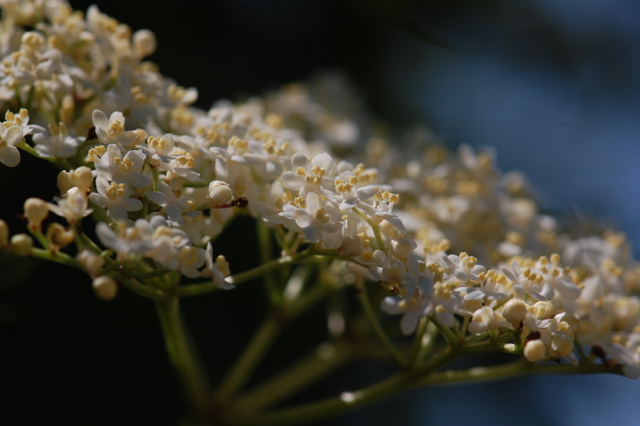
Right now the elderflower reigns supreme as Queen of the hedgerow as she decorates the land in clouds of white blooms. Elder truly lives up to its name ‘the people’s medicine chest’ as each part has some use or other for humans or animals alike.

Juliette de Bairacli Levy calls elder ‘one of the greatest of all herbs’ and I could not agree more. She goes on to inform us, ‘it is sacred to the gypsies who will not burn it as wood in their fires: they declare that a tree which can help all the ailments of mankind and can restore sight to the blind, is too precious to burn.’

Elderflower is famous as a wild food but it is not only delicious in cordials, champagne and fritters but is also a fantastic medicine, being especially useful for any condition where there is congestion in the sinuses such as in hay fever, colds or sinusitis. It is diaphoretic, anti-inflammatory and anti-catarrhal and can be prepared as tea, tincture or a cold infusion like this one below.

To make a cold infusion of elderflower all you need to do is place a few heads of the flowers into a jug of fresh water, leave to infuse for a couple of hours and drink the heavenly yet delicately flavoured water throughout the day.

Elderflower is lovely in teas combined with nettle and rose for allergies, linden blossom for a relaxing floral brew or chamomile for a gentle anti-inflammatory effect. The classic cold and flu blend includes elderflower, peppermint and yarrow, all useful diaphoretic herbs.

When gathering elderflower for tea be sure to shake off any little black bugs as you do not want to wash the blossoms- they will loose all their pollen and delicious flavour. Also be sure to remove the flowers from the green stems which are emetic (i.e. can make you vomit) and taste unpleasant as a friend of mine recently discovered when making tea with the stalks still attached! If you are making the cold infusion you don’t need to worry about the stems as the cool temperature will not extract their properties or flavour.

Much like the berry, elderflower has also been shown to have a good anti-viral effect so can help treat colds and flus, not just by countering mucus or by provoking a sweat but by a direct effect on immune function as well. Culpepper was recommending elderflower to treat colds and flus back in the seventeenth century and its use as a folk medicine no doubt goes back many hundreds of years before his time.

Finally it is also wonderful in skin care recipes. Culpepper states ‘the distilled water of the flowers is of much use to clean the skin from sun-burning, freckles, morphew the like.’ Morphew is apparently a scurfy skin eruption. Juliette writes ‘Elder lotion is an old-fashioned but excellent treatment for the complexion and hair.’ You can read about some of the ways I use elderflowers in skin care in this post here from a couple of years ago.

Read Full Post »

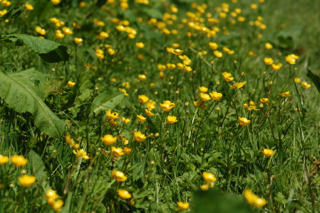
There are two plants that have been monopolising my attention in the nearby fields this last week – buttercups and elderflowers. I will be posting on elderflowers in the next few days so today’s post will be in honour of the humble but winningly beautiful buttercup.

I suspect I say this a lot, as memory never quite does justice to experience, but I don’t remember ever seeing so many large and beautiful buttercups as there have been this year, carpeting the field edges with joyful splashes of colour.

The sap from buttercups causes blistering so it is not used in modern herbal medicine, though like celandine and other plants with caustic sap, it has been employed in the treatment of warts by traditional herbalists.

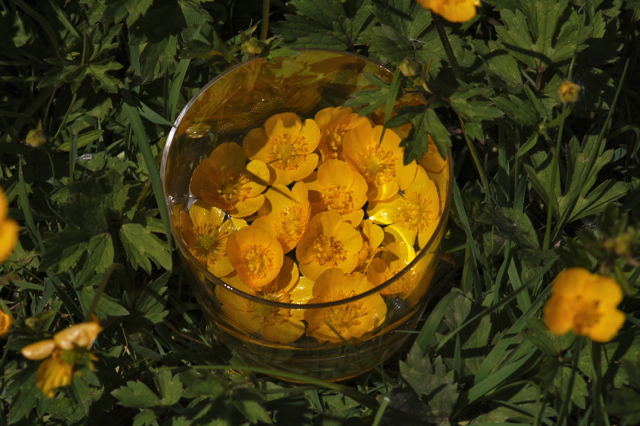
Last weekend these charmingly cheerful little blooms were aglow in the morning sunshine so I took the opportunity to get out early and make a flower remedy. If you are interested but new to flower remedy making you can read my detailed instructions here, as I won’t go into the process again in this post.

Meadow buttercup (Ranunculus acris) is truly a flower of childhood associations, so many of us remember holding the bright yellow blooms beneath our chins to admire the reflected glow, an incontrovertible sign that you liked butter!

Along with daisies they are possibly the two flowers I associate most strongly with childhood so perhaps I already had a preconceived idea that the buttercup essence would be a remedy for bringing us a sense of childlike joy and innocence to heal the cynicism that age invariably brings.

When sitting with the plants making my remedy however, the message that was most emphasised was that of trust. Trust and open hearted courage are also aspects of childhood. Before we learn to be suspicious and fearful of the motives and reactions of others and shut down accordingly, trust is our natural state of being.

Buttercup is small, common and often considered a weed as it reduces the productivity of pastureland. Yet it shines with such radiance that it appears to be lit from within rather than without.

Perhaps, with a little trust and courage, or rather with a little less suspicion and fear, we too could be like buttercups, moving beyond those things that hold us back, not believing so strongly in the cares and cautions of the mind and letting our inner radiance shine out.

Whether others consider them weeds or most radiant of wild flowers, the buttercup bestows its gifts regardless.

Read Full Post »