Feeds:
Posts
Comments

Archive for January, 2012

At last, here is the final instalment in our cream making series, apologies that it’s over a month late!

Of the three recipes I have shared this one is the most complicated as it requires precise temperatures and the use of not one, but two emulsifiers. Once you have done it a couple of times though it’s fairly straightforward and it is a reliable cream that I have never had any problems with.

This method is taught by Aromantic in their course which I attended a couple of years ago and is very popular amongst herbalists that I have spoken to.

Pros are that it makes a light and professional looking cream with a very good finish. Cons are that it involves processed ingredients like emulsifiers and cetyl alcohol and that it does really need a preservative due to the very high water content. The high water to oil ratio could be a pro or a con depending on what you want to achieve. If your key ingredients are water based, for example a strong infusion or floral water, this would be an ideal recipe to follow but if they are oil based, such as infused calendula or St. John’s Wort, then one of the previous recipes would suit your needs better.

Ingredients:

Fats:
25 ml vegetable oil/ infused oil
4 g cocoa butter
4 g cetyl alcohol
5 g VE emulsifier

Waters:
140 ml spring water/ herbal infusion/ floral water
4 ml glycerine
9 g MF emulsifier

Extras:
2 ml Vitamin E
1-2 ml Essential oils
Preservative of choice

VE and MF emulsifiers are both available from Aromantic, see the link above, and are vegetable derived, usually from coconut or palm oil. Preservative 12 and Preservative Eco are also available here.

Method:
Begin by melting all the fat based ingredients in a bain marie or double boiler. At the same time heat the water/ infusion in a separate pan or double boiler and then add the other water based ingredients, whisking well to ensure the MF powder is completely dissolved in the liquid and no lumps remain. Continue heating until both mixtures have reached between 75 and 80 C.

When both parts are at temperature, turn them off the heat but leave the water part above the bain marie to ensure it remains hot. Pour the oils in a steady stream into the waters whilst whisking gently from side to side. Don’t beat the cream too vigorously or too much air will be introduced. Continue whisking in this way for five minutes to ensure everything is well mixed then remove from above the hot pan to allow for quicker cooling. At this stage I place the container in a pan of cool water to allow it to set quicker and continue gently whisking until it is cooled to below 30 C and nicely thickened.
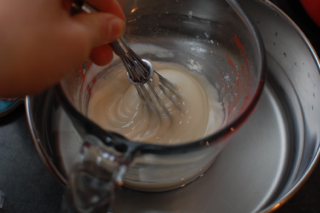
At this point I stir in the essential oils, vitamin E and preservative and spoon into jars.

And that my friends is all there is to it. Happy cream making and a very happy Imbolc to all for tomorrow.

Read Full Post »

Connections and Change

Today has been cold and rainy and now that I am settled for the evening, in front of a warm fire, I find myself in the mood for a little philosophising.

“This walk on Bindon Hill brings to the fore three important themes of landscape reading: everything changes, everything is connected, and everything has multiple causes.” Patrick Whitefield – Permaculture teacher.

For the last few years I have felt a convergence between many of the different facets of my life and an awareness of the subtle threads that run through my various perspectives. What is interesting to me is that these things are all based on experience and observation of the world around me, though they may be presented within different philosophies, ideas or world views.

Two such things which are fundamental to both my experience of nature and my love of Buddhist teachings for example, are the truth of connection and flow – or Interbeing, and the truth of change.  I may call myself a ‘buddhist’, ‘nature lover’, ‘permaculturist’ or any other number of labels, but ultimately these are just concepts that help give structure to the actual experience of living in the world.

Two of the key principles of Buddhism are that all phenomena are impermanent and that they have no inherent self. This is what I see reflected in the natural world at all times, these simple truths of change and interbeing which underpin our entire existence. As humans we tend to want things to be solid, linear, permanent and unchanging as all these qualities make life easier for the mind to conceptualise and create pattern, formula and theory from. But if we look closely we can see that nothing exists without dependence on numerous other factors in a delicate balance which allows for continuous change and transformation. Ultimately, these two truths are really one because when everything is seen to be in a state of change and flow, there cannot be said to be any independent or inherently existing self, only a kind of beautiful dance and the awareness thereof.

‘When we take a step on the green earth, we are aware that we are made of air, sunshine, minerals and water, that we are a child of earth and sky, linked to all other beings, both animate and inanimate. This is the practice of non-self.’  Thich Nhat Hanh – Buddhist monk, teacher and peace activist.

Walking on the green earth with Thich Nhat Hanh in Plum Village, France.

It seems to me that the perceived tension between the natural world and modern Western society is a reflection of the tension between our own true nature and ego or independent identity.

Where as the natural world can be clearly seen to be inter-dependant, constantly changing, selfless, connected and whole, the world of modern man is an attempt to build something lasting, stable, individual and solid. It is an attempt to shut out what, in our deepest hearts we know ourselves to be and instead create more and more strands to weave into the web that is the illusion of a separately existing self.

The current scientific culture provides a similar example. Nothing can be considered logical or ‘true’ unless the mind  can create a theory from it. Again we can see the attempt to make definitive ‘laws’ of the universe as an attempt to create something unchanging, ‘real’, and solid in order to pacify this egoic state of delusion that we are all subject to at some point. The thing that is often overlooked however is that theories themselves are continually changing. One idea of the universe is disproved and gives way to another and another and yet at each stage of development, we hang on to these theories as if they were a lifeline and desperately try to stamp on anyone whose ideas are conflicting. And it is a lifeline –  a lifeline for the ego which will destroy everything in its attempt to keep hold of the fallacy that it is a separate, unique and independently existing entity.

Life, death, decay and back again - the cycle of change.

Many of us experience a pull to nature, just as underneath the cultural obsessions with shopping, celebrity and the mundane details of life there is always a pull into own own hearts. This conflict is written through our landscapes and our lives, even though the resolution lies closer than our own breath. The clues are everywhere; in how each wave is unique but is really just part of the ocean, in how the clouds arise and pass but do not obscure the sky, how the seasons in the forest are ever changing and how the cells of our bodies die and are renewed so many times in our lifespan.

If we can open our eyes and open our hearts to look around us, we see the whole world is whispering this most plain, yet most secret of truths, and it is saying ‘we have not forgotten who we are, we have not forgotten who we are.’

Read Full Post »

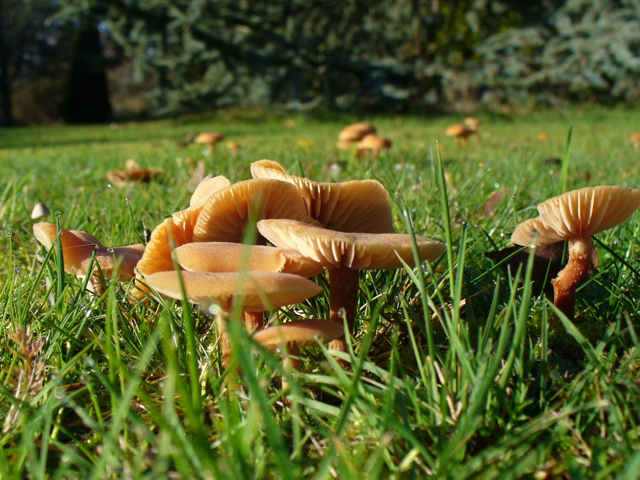
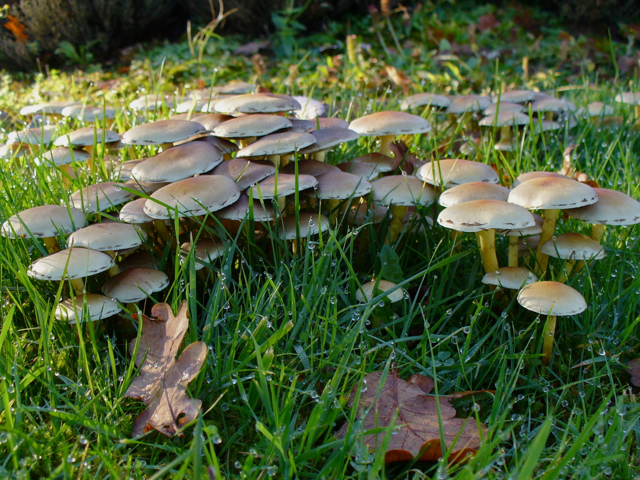
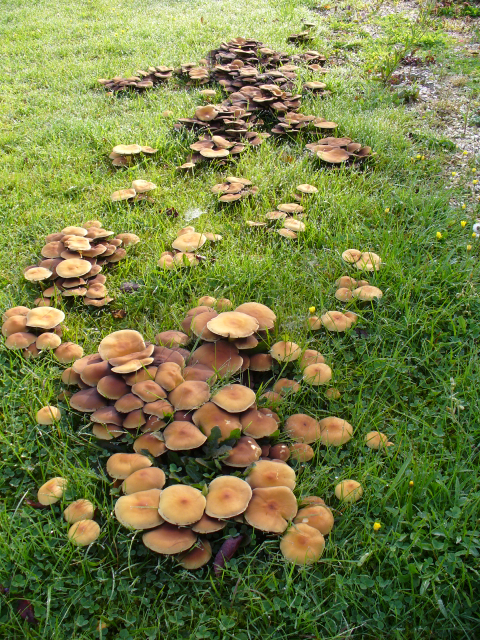
While chatting on the phone to my Dad over the autumn months, he mentioned several times how amazing the fungi around where they live have been this year, so it was exciting to look at his photos when we visited over Christmas.

There were some really fascinating species, including some that I have never seen before, so I thought I would share a selection of his pictures along with a few tidbits of information that I gleaned along the way.

I must warn you that I am far from an expert in mushroom id and I may well have wrongly identified some of these, so if anyone out there knows better please let me know. And of course don’t pick or eat anything without being 100% sure of the species.

First up we have this little beauty, Russula emetica, better known as The Sickener, it won’t take much imagination to work out why!

Also lots of common puffballs which can grow singly or in large groups and are edible when young.

These amazing fellows are Laccaria spp., I think Laccaria laccata which is the most ubiquitous, though as their common name is The Deciever and cap colours are variable, I could have got it wrong!

They start off flatish, then curl up into themselves looking like some kind of exotic sea creature and most species are edible.

There were plenty of Fly agaric, Amanita muscaria, a mushroom which never fails to bring me joy. It’s no wonder they have worked their way so firmly into folklore and the popular imagination, looking as magical as they do.

These unusual looking visitors are actually the fairly common Yellow Club but the white version below, sometimes called Fairy Fingers, is quite rare.

Here are some Common Inkcaps which, though edible, cause nausea, palpitations and other unpleasant effects when taken with alcohol. According to Roger Phillips they were once used to cure alcoholics in an ingenious form of aversion therapy!

I was very excited to see this Earthstar, Geastrum triplex, which I had read about in Christopher Hobbs’ book on Medicinal Mushrooms. Apparently it has been used in Chinese Medicine as a tonic for the lungs and throat. According to my guide books it is not considered edible but Hobbs says it is decocted into tea and drunk to reduce inflammation in the respiratory tract.

Here’s some beautiful Parasols, before and after opening.

I thought this one was a Shaggy Parasol but my Dad thought it was another common one , what do you think?

I think this is a Butter Waxcap because of the faint striations at the margin of the cap.

I’m not too sure about any of these though… ideas are most welcome!

Lots of honey fungus grows on the roots of an old cherry tree.

And last but not least and somewhat more easily identifiable, here is the man himself, in full Yule regalia. Doesn’t he look grand?

Learning more about local mushrooms and which ones can be used medicinally is high on my agenda for 2012 so hopefully by the end of the year I’ll have some more interesting information to share with you.

Read Full Post »

Last January I wrote a post outlining how I like to approach the topic of detoxing at this time of year. It is essentially about finding a middle way between the extremes of cleansing and indulgence and you can read it here. This year I’d like to expand on this a little and talk about how cleansing and nourishing, which are so often considered to lie at opposite ends of the scale, are essentially the same thing when approached with a healthy attitude.

All our organs of elimination, the bowel, the liver, the kidneys, the skin and the lungs need good nutrition to function properly. The liver requires nutrients such as magnesium, amino acids and antioxidants to be able to effectively break down the toxins in our bodies. So we can see that when we eat a simple but varied and wholesome diet, cleansing and nourishing both happen at the same time and are taken care of naturally by the body.

Unfortunately we live in a culture of extremes. I remember one of my first teachers saying to me, ‘the people who need to build are the ones busy cleansing and the people who need to cleanse are the ones busy building’. He meant it as a joke but there’s a lot of truth in it too. We humans are creatures of habit and we also get very invested in ideas which can stop us from achieving a more balanced approach to our health as we let our minds overrule what our bodies are telling us, often through attachment to one idea or style of eating.

Sometimes recognising what is going on can be problematic. We may see someone who is feeling tired, sluggish and congested and has signs of liver stagnation, constipation and poor skin. They seem to be crying out for a good detox but first we need to go deeper to find out if they have ended up here through excess or deficiency. Some people really do have an excessive lifestyle and some level of detoxification may well be appropriate for them but others are actually deficient in many of the key nutrients that are needed for the body to do its own cleansing.

Often the pattern may have elements of both, a poor diet which is deficient in key nutrients so the vital organs cannot function properly but is excessive in other things, sugar, refined carbs, grease, additives etc. It can be tempting to throw a bucketful of liver herbs at someone like this but, before we even think about cleansing, it’s vital to build up nutrient levels so the body can effectively deal with what is being moved out. This is where a wholesome diet comes into its own. Having said that, in people where there is a lot of stagnation, mucus and congestion, some cleansing will need to be undertaken before the body will be able to be properly assimilate nutrients from the food. So you see it is always something of a balancing act.

When I studied naturopathy, the approach of cleansing was emphasised and I have certainly seen wonderful results in clinic when people with certain chronic conditions undertake detoxification protocols. Often what was considered a ‘detox’ however was not taking strong herbs such as laxatives and diuretics which is what we see in many commercially available detox products, but an emphasis on the old European naturopathic principles such as fresh air, gentle exercise, a wholesome diet and adequate rest. Essentially it is a focus on the simple principles of life, detoxing from the excesses of our culture which are not just dietary but in our working lives, social lives and the sensory stimulation that many of us are surrounded by. When liver, bowel or other cleanses were recommended they were done so with the specific individual in mind not as a one size fits all solution.

Another thing which strikes me as very important in our approach to this topic is our attitude towards the food we are eating. A plate of vegetables like the one above, deliciously prepared with fresh herbs and a variety of colours looks like a treat to me but to someone whose favourite food is a big mac, it may appear like torture. This is where it can be better to approach dietary changes from the perspective of inclusion rather than exclusion. Encouraging people to add healthy choices into their current lifestyle can be much more helpful than just giving them a list of foods to avoid. Ultimately food should be enjoyed and if mealtimes become associated with misery then it will be much harder for people to heal. And feeling like you choose the changes to your diet rather than having them imposed upon you is much more empowering.

Still there’s always some people that do need to eliminate certain foods due to intolerances but this can be done at the same time as providing alternatives that will help them to transition to a new way of eating.

Whilst different diets may suit different people, a happy and relaxed approach to eating will suit everyone. So what I’m actually getting at here is this: Eat good, wholesome food, enjoy it, listen to your body and don’t worry about it too much!

Wishing you all a happy 2012 filled with delicious food, beauty and simplicity.

Read Full Post »