Mark the fair blooming of the Hawthorn Tree,
Who, finely clothed in a robe of white,
Fills the wanton eye with May’s delight.
Chaucer.

Pink and white blossoms of Hawthorn
I couldn’t let May disappear without paying homage to the Hawthorn, sacred tree of this month. It has been known by many names, including May Flower, May Tree, White May and simply The May, all referencing the beauty, symbolism and medicine of its blossom at this time of year. In fact the Hawthorn provides medicine most of the year round, not just in its blossom, but its leaves and berries too.

Hawthorns on the Sussex Downs, just before flowering.
Hawthorn has been common in Britain for millennia, pollen counts showing its presence here before 6,000 BC, and of all our native trees, it is perhaps the most enshrined in myth and legend. From Celtic ceremony, to Arthurian myth, to Christian legend, the Hawthorn has its place in all the stories that shape our land and our hearts.
In pagan spirituality, the Hawthorn was a symbol of fertility, youth and sexuality and was considered sacred to the Goddess. It is believed that in Celtic times, most marriages took place at this time of year, usually at Beltaine, the cross quarter festival marking the mid-point between the spring equinox and the summer solstice. Hawthorn would have been in full bloom, bringing abundant blessings to the newly weds. Today, its historical symbolism and its affinity with the heart have resulted in it being considered the tree of love. Despite marrying in August, we used branches of Hawthorn, among other trees, in our wedding ceremony last year.
Reacting against its saucy pagan associations, the Catholic Church made the pure white blossoms a symbol of the Virgin Mary and of chastity. It was also said to be the wood from which the crown of thorns worn by Jesus was made. The Glastonbury Thorn, which flowers once in May and again at Christmas was said to have grown from the staff of Joseph of Arimathea, which took root when he brought Christianity to the British Isles.
There are thought to be up to 1,000 species of Hawthorn worldwide, the two most common in the UK are Crataegus monogyna and Crataegus laevigata. Usually white, the blossoms may also be a light or deep pink.
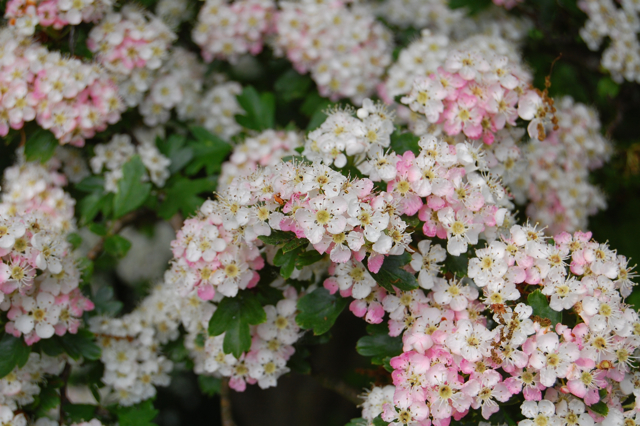
Pink Hawthorn
In medicine Hawthorn is most commonly associated with the heart and circulatory system. Both the blossoms and berries are useful and many herbalists combine preparations of the two. The berries and leaves are considered warming and drying whilst the flowers are slightly cooler in nature. Seen as a restorative of the heart, it is non-toxic and can be used safely by most people, though some care must be taken with those already on heart medication, it’s best to check with a qualified herbalist in such cases. In fact Hawthorn is regarded as one of the few Western adaptogenic herbs, having the ability to balance blood pressure, aid in convalescence and regulate sleep. As a herb of Mars it was seen as dynamic and stimulating, however it was also considered an antispasmodic and sedative to the nervous system. Like so many of our multi-faceted herbal allies, it’s impossible to squeeze into any one simple definition.
Both flowers and berries are healing to the heart muscle and arteries, being rich in flavonoids and other chemical constituents, I’ll be considering the berries in more depth when they are in season.
My own experience is that the berries are slightly more stimulating, partly due to their warming quality, where as the flowers make me feel relaxed, comforted and slightly blissed out. The tea has a lovely subtle honey flavour which eases tension and opens the emotional heart. Along with Rose, which I recently posted about, I see Hawthorn blossom as the most important remedy for helping open the heart. See how the beautiful blossoms open to reveal their pink stamens, reaching out.

Hawthorn blossom -opening the heart
One thing that intrigues me is how both the Hawthorn and the Rose have this incredible affinity with easing our emotional barriers and opening us up to feel and embrace our experiences deeply, yet they both have these very protective and somewhat savage thorns. They seem to symbolise how vulnerability and protection are not mutually exclusive, how being open doesn’t mean being weak. After meditating on this a while I came across this great article by American herbalist Jim Mcdonald who speaks of his experience with thorn medicine.

Hawthorn’s Thorns
I love the Hawthorn unashamedly and use it mostly as a tea, tincture and flower remedy. A tea made from the fresh leaves and blossoms is my favourite but I usually dry some for use later in the year too. Some people hate the distinctive, musky aroma given off by the pollen during May which is supposed to contain triethylamine, one of the first chemicals produced from dead tissue. To me however, it smells rich and heady and I can always imagine the bees drunkenly loading up on this wonderful springtime treasure!

Drying Hawthorn
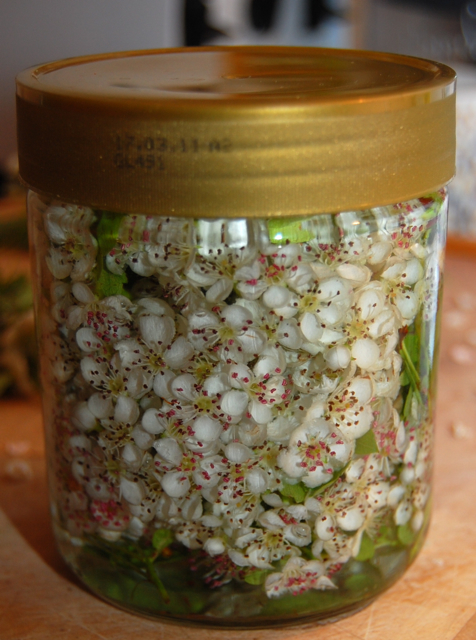
Hawthorn Tincture
 Whispering Earth