I’m very happy to be joining in the UK Herbarium’s monthly blog party, the topic of which is ‘emerging from winter with herbs’.
This immediately makes me think of fresh spring growth to tonify and cleanse the system after the stagnancy of winter months. However it’s still a wee bit early for harvesting nettles for soups, cleavers for green juices and chickweed and young dandelions for strengthening salads. So I decided to think about this topic practically instead of intellectually. What am I actually taking at the moment?
It’s still cold outside, though the first glimmers of spring are tantalisingly close, whispering of new shoots and green buds and the gentle stirrings of our own awakening senses. As a constitutionally chilly being I’m still loving my warming herbs but have been drinking less spicy teas and can’t seem to get enough of one of my favourite all time brews, Rosemary and Melissa. Rosemary is a wonderful warming herb and Melissa is also said to improve the circulation and the two together have a lovely, balancing effect on the emotions. Rosemary is a herb of the Sun and Melissa of Jupiter, so they are both joyful and cheering on a gloomy day when we are beginning to wonder if winter will ever end. I often team them up as essential oils too, for use in the bath and massage blends. Together they smell divine!
The other thing I’m having a lot of at the moment is the adaptogenic herbs, especially the Ayurvedic herbs Tulsi, Shatavari, Ashwaganda and Gotu Kola. Though the latter is not always classified as an adaptogen, it has many of the same properties and is classed as a rejuvenating herb, or rasayana, in India. Though I primarily use western herbs that I can grow or forage myself, I do have a somewhat guilty love of Ayurvedic plants, probably born of many happy months spent in India. I had a somewhat unsuccessful attempt at growing Ashwaganda last year but my Gotu Kola has done well so far and, as all my gardening currently takes place in pots, I shall be sure to try again when I have a more suitable situation. Adaptogens are so great during these strange ‘inbetween’ times, neither winter nor quite yet spring, when energies are starting to move in us and runny noses and colds can result from the body ridding itself of the congestion of winter. Inbetween times have a special magic all of their own, like twilight or those strange, still moments during a break in a long journey. Adaptogens are great to strengthen and support the system during times of change as they help us cope with mental, physical and environmental stresses as well as being wonderful for our immune systems.
As one of our feline companions, and soon to be guest blogger, goes by the name of Tulsi, I thought I’d say a little more about this beautiful herb.
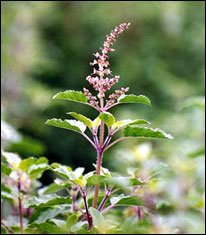
The first time I saw Tulsi, often referred to as Sacred or Holy Basil, (Ocimum sanctum, Ocimum gratissimum) it was growing plentifully in a temple in India. Revered as the holiest of plants it is seen by some as the physical incarnation of the Goddess, reborn on Earth for the benefit of mankind. A leaf held in the mouth at the time of death is said to ensure passage to the heavenly realms and watering the plants is thought to purify one of many sins.
Tulsi is antiviral and antibacterial which, along with its immunomodulating properties and high levels of antioxidants, make it protective and strengthening. Energetically it’s classed as pungent, sweet and warm, perfect for this time of year and it has been shown to help rid the body of mucus, aid in the treatment of bronchitis and lower fevers. It’s also antidepressant, so good for banishing those winter blues. Add into the mix its hepatoprotective (liver protecting) qualities and its ability to balance blood sugar and you can start to see why it’s valued as one of the most important herbs in Ayurvedic medicine. Ancient writings also speak of its efficacy in treating kidney disease, arthritis and skin disorders and its use in purifying polluted air and as an antidote to insect and snake bits.
David Winston and Steven Maimes write in their book on adaptogens that Tulsi is “capable of bringing on goodness, virtue and joy in humans.” I have certainly found this true for both the varieties of Tulsi pictured below. 🙂



 Whispering Earth