We had a lovely evening at last week’s Potions group in which I taught about how to make your own herbal infused oils.
We made a soothing calendula oil and some salve with comfrey infused oil.
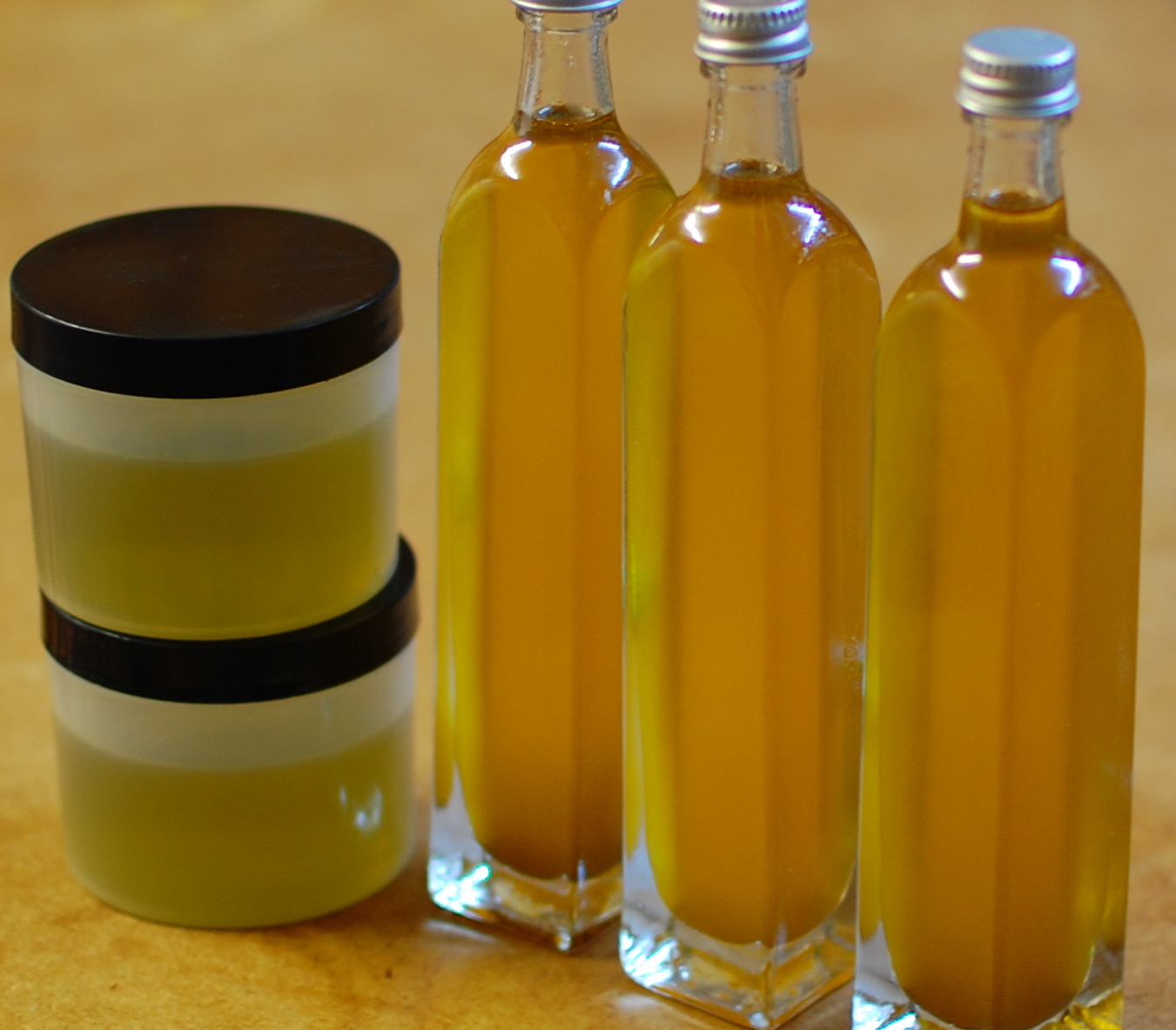
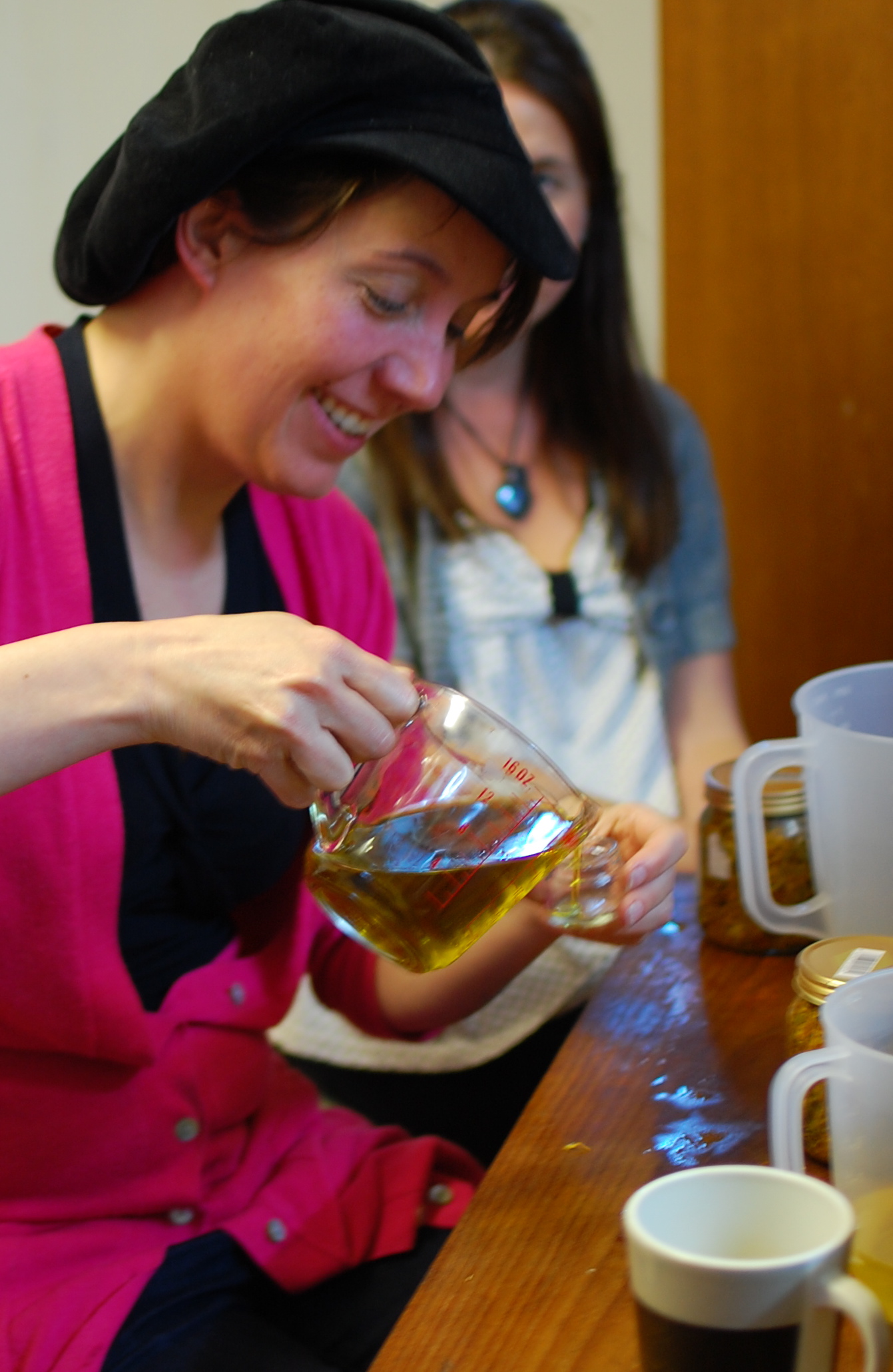
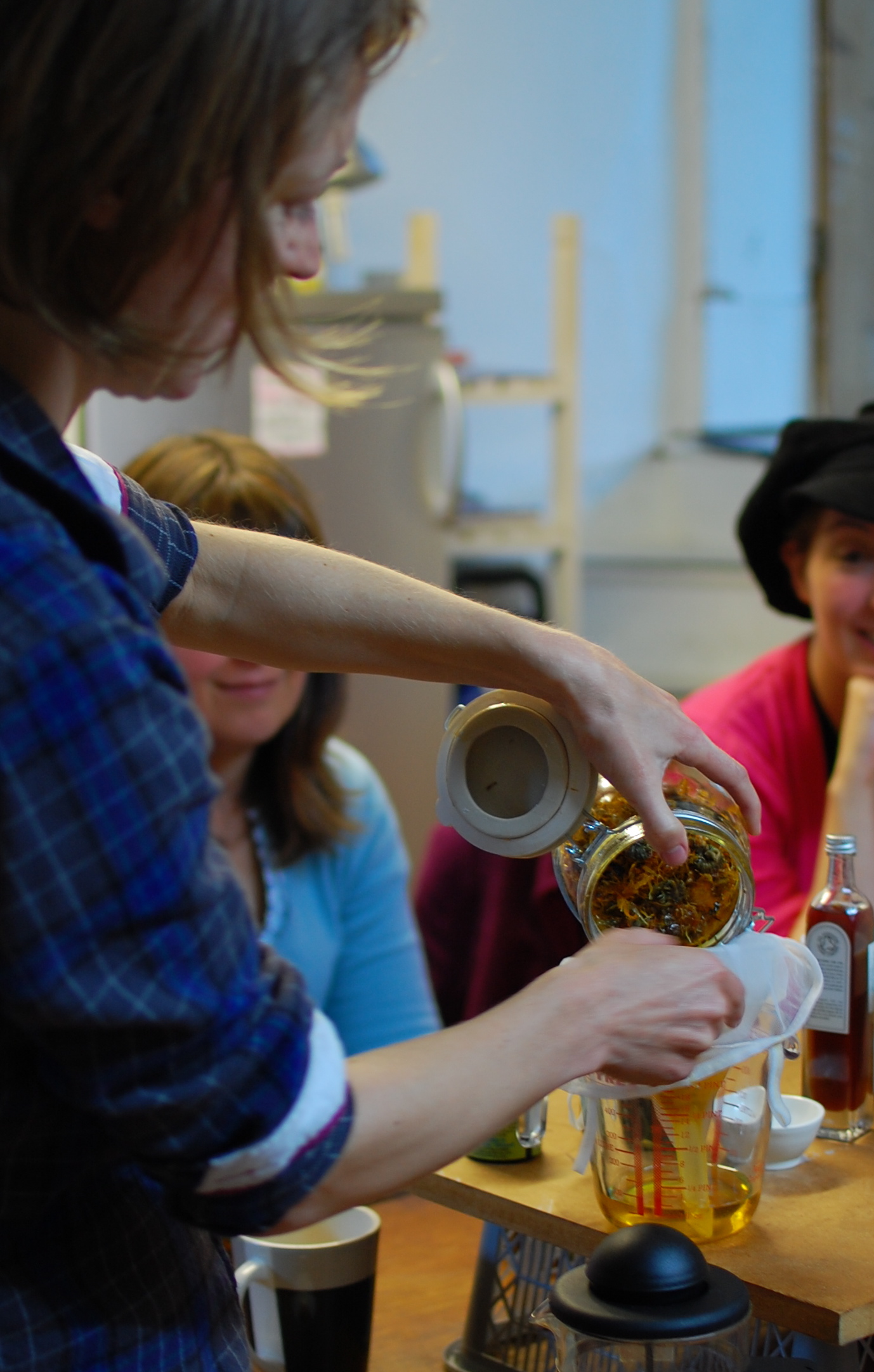
Here are some of the group straining, pouring and bottling their oils.
______________________________________________________________________________
Here are the notes I wrote for the class for those of you who are new to herbal infused oils, including two simple methods and some basic recipes.
Herbal Infused Oils
Oils infused with herbs are a lovely way to utilise the healing properties of plants which contain volatile oils and fats. Unlike essential oils they are easy to make at home and usually very gentle on the skin. You can use them to make massage oils, to heal skin problems, or to make lovely subtly scented balms and creams.
Plants containing volatile oils are generally those commonly used in aromatherapy. Aromatic plants such as lavender, rosemary, thyme and sage make lovely infused oils, as do peppermint, melissa, chamomile, rose, yarrow, juniper and pine. You can experiment with any plants that you know have a high volatile oil content.
Also plants that have a high level of other fat soluble components; including fat soluble vitamins, antioxidants, resins and saponins, can be extracted by macerating in oil. Calendula is a good example. When you pick calendula flowers you can feel how resinous and sticky they are, a good sign they will work well in oil. Other suitable plants include comfrey, St John’s wort, viola, plantain and mullein.
You can use a variety of different oils as the base, or menstrum, for the infusion. Olive is classic for the leafy herbs, sunflower is lovely for calendula, sweet almond or apricot make a great base for creams and jojoba is light and well absorbed.
How to Make Infused Oils:
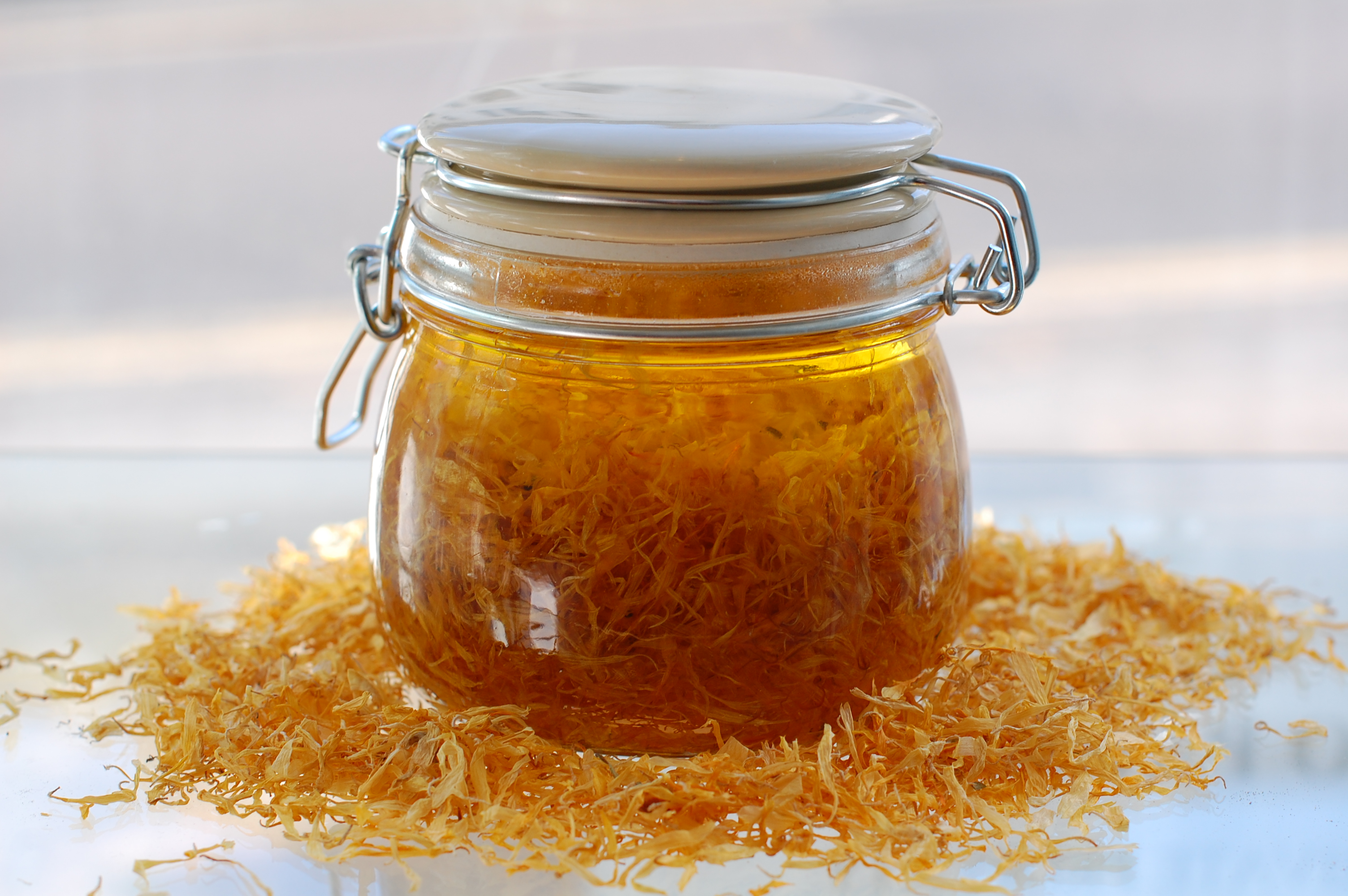
The Sun Method-
- You can generally use dried or fresh plant material when available, though some herbs, such as calendula work better as dried and others, such as comfrey, are better from fresh.
- If using fresh herbs, pick them on a dry day after the sun has dried the morning dew.
- Make sure you pick clean plant material from an area you can be sure has not been sprayed with chemical fertilisers. This is particularly important as you are not going to wash the plant material, you want it to be as dry as possible to prevent spoilage, though you can bush off any dirt with a soft bristled brush.
- If using leaves such as comfrey or plantain, it’s good to let them wilt overnight to reduce some of the water content but flowers are best used fresh.
- Chop fresh leafy herbs finely and lightly fill a completely dry jar with the material. Its important to cut the herb first as it exposes more of the plant to the oil, making for a better infusion. Flowers can be put in whole and dried herbs will most likely come already cut.
- If using fresh herbs you can pour the oil of your choice straight on but if using dried, its nice to warm the oil first in a bain marie to get things going. Fill the jar almost to the brim with oil as an air gap will promote oxidation and spoilage.
- Stir the contents with a wooden chopstick or glass stirring rod until all the bubbles have dispersed and cap with a lid or a piece of kitchen roll held in place with a rubber band. This works well for fresh plant material as it allows moisture to escape.
- You can leave it to infuse on a bright sunny windowsill or in a nice warm spot such as beside the boiler or in an airing cupboard. I like doing calendula in the sun but it’s best to leave it somewhere that is consistently warm and windowsills can get cold at night which encourages condensation.
- Stir every day for the first two weeks then leave to infuse for another two to four, that’s four to six weeks in total. Calendula and some other oils are nice to double infuse- leave for 3 weeks, strain, then fill the jar with fresh flowers and pour the partially infused oil back on top and repeat the process.
- Don’t forget to label your jars so you remember when to strain them. Strain through a sieve covered in cheesecloth or a jelly bag. If you used fresh material it is wise to let it stand for a week and check if any water has settled in the bottom of the jar. If so pour off the oil and discard the water.
- Bottle the resulting oil and label and date.
The Heat Infusion Method:
This is a quicker method if you need to prepare your oil for immediate use.
- Use about 50-75g of dried herb, or 75-100g fresh herb per 300ml base oil. This is an approximate amount as some herbs are bigger and fluffier than others! Basicially you want the oil to just cover the dried herb.
- Place the oil and herbs in a double boiler or bain marie with a tightly fitting lid over a pan of gently boiling water.
- Allow to infuse at a continuous heat for 2 hours making sure the water does not boil away! Stir every half hour or so and check the progress of your oil.
- Strain and bottle or repeat the process if you desire a stronger, double infused oil.
- Always remember to label and date your products.
Some Simple Recipes for infused Oils:
Comfrey Salve:
Ingredients:
70ml Comfrey macerated oil
25g Grated cocoa butter
5g Beeswax
- Melt the cocoa butter and beeswax in a double boiler or bain marie over a pan of boiling water.
- Add the comfrey oil and stir slowly until completely dissolved. Don’t allow the oil to start to bubble, turn the heat down immediately if this happens.
- If you would like to add an essential oil then do so now, mix well and pour into jars. Leave to set in the fridge for a few hours before using liberally.
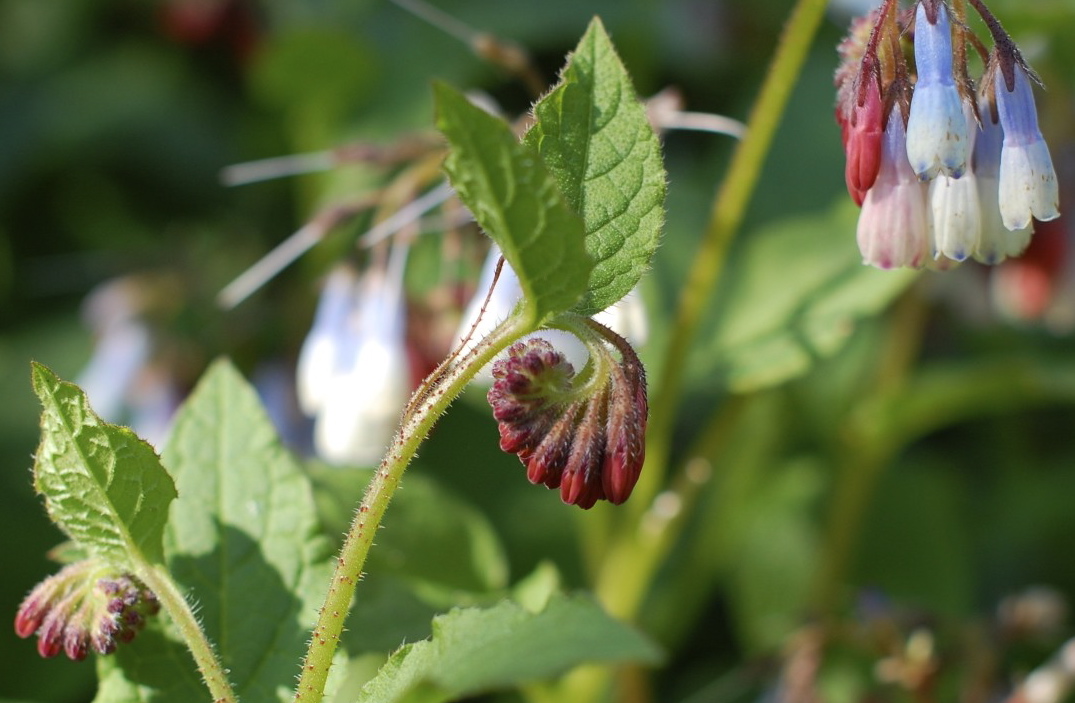
Comfrey has a long history of traditional use for healing damaged tissues such as strains, sprains, broken bones and slow healing wounds. Its common name was ‘knitbone’ and it possesses profound healing capabilities which enable it to aid in the ‘knitting’ together of tissues. It may also be helpful for inflammation and rashes. Comfrey oil is not recommended for internal use or use on broken skin but you can use this salve freely for bruising or any injury of the muscles or bones. Even if you have to wear a cast you can rub the slave into the skin at the top and bottom to help the bones heal strong and healthy.
Simple St John’s Wort Lip balm for Cold Sores:
Ingredients:
60ml St John’s wort infused oil
15g Cocoa butter
15g Shea butter
10g beeswax
25 drops Melissa Essential Oil
25 drops St John’s wort tincture
25 drops Melissa tincture
- Melt the cocoa butter, shea butter and beeswax in a bain marie over a low heat and when completely liquid add in the infused oil and mix thoroughly.
- Add the Melissa oil and the tinctures and whisk lightly with a fork to ensure the tinctures are well mixed with the oils.
- Pour into small jars and use liberally when you feel the first tingle coming on.
St John’s Wort and Melissa are both anti-viral and therefor helpful for treating the herpes virus that causes cold sores.
Rosemary Warming Massage Oil:
- Infuse fresh rosemary in oil according to one of the methods detailed above.
- To 100ml of the oil add 10 drops rosemary essential oil, 5 drops ginger, 5 drops black pepper and 5 drops cardamom.
- This would be a wonderful oil for promoting circulation and easing sore muscles and joints.
 Whispering Earth
Thanks for this info! I might try one of the recipes, the class seemed like a lot of fun!
LikeLike
Yes they’d be great in hair products, especially the classic hair herbs like rosemary, chamomile and sage!
LikeLike
This is great! We will have to try the longer/sun method. We made comfrey salve using heat to infuse the oil. Is one method better or more effective than the other?
LikeLike
Hi S, I think it depends on the herb. I like the sun method for Calendula and St. John’s Wort but both seem to work well for Comfrey. Some fresh herbs can go off a bit using the sun method so heat can be preferable. If the sun is very strong where you are it can be too intense – though this is never a problem in the UK!!
LikeLike
[…] infuse where appropriate. For a detailed explanation of how to infuse an oil see my previous post here. Elderflower […]
LikeLike
I just came across your site and love it1 I have always wanted to try infusing oil. My question is , can I leave it indoors on the counter or do I have to put it in a cupboard like the ones in my kitchen?
Thank you so much.
LikeLike
Hi Rohini,
They often work better left out on a windowsill in the sun or at least in a warm place such as an airing cupboard. I always make mine sun infused or with the heat method. I never put them away in a dark place to infuse and they all seem to have come out well and have a decent shelf life. The counter would be fine to leave them on as long as it’s not in a cold room.
Hope that’s helpful,
Lucinda
LikeLike
Thank you for sharing Lucinda.
Hugs,
Rita
LikeLike
oh I am so happy to have found you…!!! just made some comfrey oil today..put some in jars covered with paper towel and put in hall cupboard..medium dark..but have a big counter gets light ..would that be better? also cut up comfrey and put in double boiler covered with oil and have been cooking for about 2 hrs..but no top should i have used a top? also can you use a crock pot..grew a bunch of calenula last and this year..wanted to make oil from that and was hoping i could use the oil sooner than later..to make a salve.I have both fresh and dried. sorry so many questions ..just happened to be doing all this today and found you!!! also making lavender oil but will check your site first..and I love the name of you site and picture and Dr. Bach!! thanks lizzy r.
LikeLike
Hi Lizzy,
I’m so glad you like the site, I will try to answer your questions as best I can!
I would put your comfrey oil in the sunlight as the warmth and light from the sun is what helps the herbal properties infuse into the oil. I know it seems odd as other herbal preparations you would want to keep out of direct sun and heat and certainly all of them you would store in a cool, dark place once they are made. I think because oils are thicker and fatty they need a bit of a boost to absorb all the properties like the volatile oils which are easily released with heat.
I wouldn’t worry about the top on the pan as long as you are sure that nothing can get in your oil, beware of condensation running down the sides and into the oil for example. If you think some water may have got into it then leave the oil to stand for a few days until the water has separated out and pour the oil off. If you are using fleshy leaves like comfrey it can actually be better to keep the lid off so moisture can evaporate off. However if you are doing an aromatic oil like lavender or rosemary then be sure to keep the lid on as the essential oils will readily evaporate off and you’ll loose some of the scent and properties of the oil.
Yes you can use a crock pot. Just keep it on a low heat for a couple of hours. I sometimes do my oils on the lowest heat in the oven and that works quite well.
For your calendula oil you can use the dried or fresh but if using fresh, allow it to wilt overnight to reduce some of the moisture content. I often use dried for Calendula and double infuse it.
Hope that helps!
LikeLike
Thankyou for all that info…. I just love doing this and am so happy to find you..the passion and compassion you seem to have for this is wonderful..thanks for sharing so much..tata for now! lizzy
LikeLike
hello again!! just love your site quite a joy to check out thanks so much…I was wondering about making lemon verbena oil..I love the plant and have a few …some times i dry it and now i was thinking it would be nice to make oil…for use in salves and so on.. what would be the best carrier oil for this ..also eucalyptus leaves..what would be a good carrier oil…is there a list somewhere with this info. i would love to just do some but it is a bit costly when buying some of the carrier oils…so I will listen for the whispering earth to guide me…take care elizabeth r.
LikeLike
Hi Lizzy, I think lemon verbena would make a fantastic herbal infused oil. Any base oil that is light in smell and heat stable will be fine- sunflower, a light olive oil, almond and apricot are all good choices. A good quality organic sunflower is useful for most infusions and good to have on hand. It would be good for the Eucalyptus leaves too.
I have had a few questions regarding oils recently so I will try to get a post together in the next few weeks about the properties of different base oils.
Take care and enjoy your oils!
LikeLike
Thankyou ..I will work on that today…sure do wish i lived in your neighborhood. instead of borrowing that cup of sugar from your neighbor it would be more like a cup of calendula oil…..love all the pictures you post…they are like getting a glimps of heaven…take care lizzy
LikeLike
I love this post. I might need it very soon. I want to make a hair mud wash and I’m running out of lavender essential oil so I figured I’d give making infused oil a try since I have every base oil.
LikeLike
I’m sure that would be beautiful!
LikeLike
Hi I just stumbled upon your website. Thanks so much for the great information. Which way do you feel is the best to infuse herbs in oil? We live in the North east so we are limited on sunny days. Would it be ok to place a jar in the window during the day and a t night place on a counter? Or is it best to wait until Summer or try the double burner approach?
Any info you can share will be helpful!
Thanks so much!
LikeLike
I like the windowsill approach in summer but at this time of year I generally do a heat infused oil as it is easier and often works better with dried herbs which is what I am likely to be working with over winter and early spring before things have got growing.
You can also do it in the oven but on the very lowest heat so you don’t cook your oil and herbs!
I do like the sun infused method for very delicate flowers like elderflower, rose petals or violets but otherwise the double burner method is probably the best.
It’s helpful to double infuse too if you want a more potent oil.
Hope that helps!
LikeLike
After I have infused oil with flowers, can the remaining flower heads be used for anything? I’m thinking maybe they would work in homemade candles or even incense, although I’ve never made either (yet!). Any suggestions? Thanks!
LikeLike
I think it would depend on what flowers you were using. Something like rose petals or elderflower will start to brown and go a bit soggy once you take them out of the oil. I usually just compost them to be honest. Something more robust like calendula would work well in candles though. I haven’t tried it myself but they hold their shape well so I don’t see why not!
Let me know if you give it a go!
LikeLike
I recalled that I have a “Scentsy,” gadget that slowly heats scented wax in a dish over a light bulb. So I am trying my oil infusion with the oil and herbs in a glass mason jar, set over the top of the light bulb. So far after 3 hours the oil is just nicely and gently warmed. Think it should be effective and safe to leave it like this. It looks pretty too with the light shining up through the oil and herbs. Like artificial sunlight. Living in MN in March, there is not a lot of warm sunlight yet.
LikeLike
I haven’t heard of one of those before but it sounds like it will do the job perfectly. 🙂
LikeLike
Hi Lucinda. I just stumbled on your site a few days ago and have been back every day since for more wonderful information! Thank you SO much! I am very new to herbal products and your site is so very encouraging to me. My first of probably many questions is what is the shelf life of an infused oil and what is the best way to store it? I can’t wait to get going! Thank you again so much for the wonderful site!
LikeLike
Hi Sarah,
Thank you. 🙂 So glad you are finding something useful here.
The shelf life of infused oils will vary depending on how they were made and if there is any water in the oil. If you use fresh plant material and any water remains they can go off quite quickly. It’s good to keep an eye out for any moisture settling at the bottom and then pour the oil off the top to keep it fresh. If using dried plant material there won’t be much moisture and they can last a couple of years in my experience.
You can always tell when an oil is going off by the smell so just keep an eye on it and trust your senses.
LikeLike
Hi Lucinda. I absolutely love your blog, it is so inspiring. I want to make a comfrey salve to use on a bone fracture. To make the infused oil I just have to do with the dried version at this time of the year. Would you recommend using comfrey leaf/herb, or comfrey root for this kind of salve? Or can I use both, and what are their different medicinal propperties? Thanks again, Sina
LikeLike
Hi Sina,
Sorry for the delayed reply! I would recommend using both but you can use either part as they are both very mineral rich and healing. All the best. x
LikeLike
Hi Lucinda,
I dried some rose petals and tried the double boiler method and i am wondering if the infused oil should have a strong smell.?It seems to me that it just has a wiff of rose in the background,,,Do you think this is ok or should it have a stronger scent?
Thank you,
Lucinda
LikeLike
Hi Lucinda,
Infused oils vary in scent, sometimes they aren’t that strong. It will still be fine to use but if you want it stronger you can try double infusing. All the best. x
LikeLike
Hi Lucinda
I love your website and all the information – it’s great. I started infusing comfrey in oil on sunny windowsill a week or so ago and it really stinks, a bit like a mature cheese. Is this normal?
Thank you, Linda
LikeLike
Hi Linda,
That is usually a sign that too much water was in your jar. Did you wilt the comfrey leaves first and cover with a muslin or kitchen towel with a rubber band rather than the lid? This allows any excess moisture to evaporate.
LikeLike
Hi Lucinda
Yes, I wilted them overnight and then covered with muslin and rubber band. Do you think it is still usable? I was going to try it for my dog, Brummell, who has slipped discs. He would be self selecting.
LikeLike
How stinky is it? They can be a little bit smelly sometimes but if it’s totally disgusting it doesn’t sound quite right. Though if Brummell is self selecting I would trust his ability to know if it will do him good or not. Do you practice Zoopharmacognasy? I started studying it last year, very fascinating!
LikeLike
I’ve just had another smell of it and it doesn’t seem too bad now. I have followed your directions above and it is now a month old so I suppose I could strain it any time from now on. Yes I must admit I don’t mind offering it to Brummell but wouldn’t be too keen on it myself! I recently read Caroline Ingraham’s book following a healing and self selection session with a healer with both my dogs. They have been self selecting various oils since with really good results. I really love your website and think you are doing a wonderful job getting all this information out for everyone. So often one reads about doing things but they always leave out the vital bits one needs to know. Just one other question – is it all right to use nettles now or will they not have so much goodness? I mean fresh growth where they have been previously cut. With many thanks, Linda
LikeLike
That’s great. I have done a couple of weekend courses with Caroline and really hope to do the full zoopharmacognasy course someday. It’s fascinating isn’t it, but it makes so much sense too.
Fresh growth of nettles will be fine to use, not quite as vital as the spring ones but still really full of minerals. Just best to avoid them after they have flowered, though you can pick the seed also now which has many healing properties too.
Take care. x
LikeLike
Thank you very much Lucinda. I will let you know what Brummell thinks of the comfrey oil! Many thanks, Linda
LikeLike
He is selecting it! So hopefully it is doing him some good. Thank you for all your help. Linda x
LikeLike
Great news! I hope it helps him. 🙂
LikeLike
What a delightful website! Thank you. I harvested peppermint today and started infusing it with grapeseed oil. Learned that I need to “cut” the leaves and I really want to use heat. Glad to read I can use my crock pot, Thanks again, Kim
LikeLike
I was wondering if you use dried St John’s Wort or does it have to be fresh? If fresh…what are the reasons for fresh not dried?
LikeLike
Fresh is best. Some of the important healing constituents are in the little glands that look like holes when held up to the light. The oil from these is best extracted fresh – though I have never made an extract from the dried herb so I can’t really say that from my own experience. 🙂
LikeLike
I was wondering if you used dried St. John’s Wort or fresh?
LikeLike
hi, just read this and I will give it a try one of this day. I’m planning to make a chamomile infuse oil. A quick question, can this infuse oil be used as a carrier oil for essential oils? Thanks
LikeLike
Yes absolutely! Combining infused oils with a little essential oil can give really lovely and highly therapeutic results. 🙂
LikeLike
Please forgive me if this question has already been answered, but I was wondering how long these oils keep? I wanted to make them ahead of time for Christmas, but am reading that they only keep for about 1 week in the refrigerator. Thank you!
LikeLike
Hi there, sorry for the delayed reply. It is not advised to eat infused oils that have been stored in the fridge longer than a week or two because of the risk of botulism developing. Externally they are usually fine for a year or so, especially if you use dried herbs as there is much less likelihood of them going off.
LikeLike
Thank you so much!
LikeLike
Hi Lucinda,
Thank you for a very useful article. You say botulinum is safe to use externally, but I have read various articles about the danger of this bacteria/toxin infecting wounds. So do you think infused oils can still be made into a herbal salve to be used on cuts or wounds? Thanks for any advice!
LikeLike
Hi Lucinda,
Apologies for the wording – when I wrote “You say botulinum is safe to use externally….” I meant “You say infused oil is safe to use externally….”
LikeLike
Hi Wayne,
No worries I know what you meant! Well firstly I don’t think salves are the best preparations to use on open wounds as they can seal in bacteria. Generally I use a herbal wash or a powder for open wounds and then a salve as things are stating to heal over. However I do use salves on small cuts, grazes and scrapes and have never heard of any cases where there has been a problem, though it is potentially possible. I would stick to using dried herbs for salves to be used on cuts as it is the water content of fresh herbs that creates the possibility of bacterial growth.
LikeLike
I am infusing grapeseed oil with ginger and yarrow right now. I used fresh ginger without any drying process. The oil has been infusing for 3 weeks and seems fine (no water seperation) and smells amazing. I’m worried that using the fresh ginger will have added water to the mix and will decrease the shelf life. What do you think?
LikeLike
It sounds wonderful! I can almost smell it now. 🙂
If it smells good then it will be fine for external use. When you strain and rebottle it look to see if there is any water separated out, if not you are fine but even if there is you can just decant the oil off and shouldn’t have any problems.
LikeLike
hi lucinda
thanks for this lovely site:) i made 2 lots of calendula infused oil from my garden this year but am bit concered about mold – i heard it can be fatal- i cant see any mold and they smell sort of ok there is no clear mold smell but im not sure how they r meant to smell ( they smell a bit different to each other)
any thoughts on how to know if modly/dangerous?
thanks:0 jj
LikeLike
You only have to worry about botulism if you are planning to take them internally. If they smell ok and are for external use then you don’t have to be concerned about it and can enjoy them freely. 🙂
LikeLike
Hi Lucinda
I wnat to make some vanilla infused jojoba oil. Do I just leave it on the counter top for 4-6 weeks.? Obviously I don’t need the sun for this , right?
Kind Regards
Rohini
LikeLike
Hi Rohini,
The sun would speed the process but you don’t need it, just be sure to leave you oil somewhere warm. I would check it regularly and if you want it stronger you could add new herb after 3 weeks or so and leave for another 3 before straining or otherwise 4-6 weeks should be plenty if it seems strong enough with just the first lot of herb. x
LikeLike
I grow peppermint,sperimint plants an want to make homemade oils how do i do it myself from fresh plants ?
LikeLike
You can follow either of the methods above for your fresh mints. Double infuse for a stronger smelling oil.
LikeLike
I just come across this article while wanting to learn how to make my own oils with the peppermint and spearmint I am growing too….so Melissa, how did it turn out? and what kind of oil did you use as a carrier? what kind of shelf life has it had?
LikeLike
Melissa oil is lovely, it captures the fragrance well. Mine has always lasted a year but I have generally used it up in that time!
LikeLike
Do you think its possible to infuse pearl barley and white tea? I’m not sure if I just put the pearl barley in or I need to soak or roast it first? Help please.
LikeLike
I can’t help you I’m sorry as I’ve never tried infusing grains. I doubt that much would be absorbed from the dried grains into the oil but as I say i have no experience in doing this.
LikeLike
Have not used pearl barley, have used pepper corns putting them through a pasta maker just enough pressure to burst the outer slightly, but do wear eye protection.
Great site by the way!
LikeLike
Hi Lucinda, I have just discovered ‘u’ and am finding it all very encouraging; I have started to make a heat infused calendula oil based on your recipe. Is there a list somewhere that you know of which would specify as to which herb is best used fresh and which dried and also which method (solar/heat) would be a better option for which herb? Also, for the solar method, should one place the oil in direct sunlight?
Sorry for so many questions but I am super excited to learn more!
LikeLike
Hi there,
I don’t know of a list as it is quite a personal thing, some herbalists prefer dried plant material and others fresh so it’s a bit of trial and error really. I prefer to use fresh herbs if the plant is tougher and contains volatile oils, like rosemary, lavender etc. For plants that are fleshier and contain a lot of water, like comfrey leaf, you can either part dry the fresh leaf over a couple of days just to let some water escape or use dried. I often use the heat method because it is quicker and often works better for dried plant material. Fresh plant material works with either method as long as there isn’t too much water in the plant.
Yes you can place the oil in direct sunlight but I usually only do that for a short time so as not to oxidise the oil too much.
Hope that helps. 🙂
LikeLike
Lucinda, thanks for the lovely article!
In the heat infusion method, I wonder if it’s OK to do a little more to get more out of the leaves. This is what I have in mind – after the leaves turn crisp and a different shade of green in the warm oil, strain them out, cool them a little, and then grind them. Then add the ground leaves back to the oil and again warm it all up a little. Let the mixture stay for some hours and then strain out the leaves. This would give a deep green oil even with light colored oils like VCO. Would this work for herbal infusions such as rosemary in olive oil? Or do you think the flavor would be too intense for consumption?
Another question, for rose infusions, what is a good carrier oil?
Uma
LikeLike
I think that once the leaves go crisp there won’t be too much goodness left in them but you could give it a go and see. It would also be hard to strain all the ground herb out at the end.
Finally the methods I have shared here are for external use only really as you have to be very careful about botulism when making infused oils for consumption.
All the best.
LikeLike
Hello we are trying out fresh herbs & spices in oil for cooking but would like to know test if their ready or need more time? would dipping it in bread work or other method?
LikeLike
Hi there, this recipe is for external use only as you have to be careful of botulism with infusing oils, particularly with fresh herbs, for consumption. I would look for a recipe that is specific for edible oils and hopefully that will answer your question. All the best.
LikeLike
can you use joba oil to make scented burning oils??
LikeLike
I just discovered your site and I love it! I wondered what ratio of dried powdered herbs and oil would you use for the sun infused method.? I tried 130g of oil (half sesame and half coconut oil) to 70g of powdered herb.The consistency is like gritty yogurt or soft porridge. I am wondering if it is too thick. It has been in the airing cupboard for 10 days.
LikeLike
I personally prefer to use finely chopped herbs rather than powders as powders are harder to strain out of the finished product. If you let the oil drip through some fine muslin then it shouldn’t be too thick after straining even if it seems a bit thick now.
LikeLike
Hi Lucinda, I just came across your site, I’m a fellow Brit transplanted in Seattle since 1990! Thanks for putting so much great info on your site. I’ve gone to some herbalist classes in my local area, and just recently got into infusing for medicinal reasons. I currently use my Excalibur dehydrator at 115 farenheit for 3-5 days, and they come out well. I just need to figure out the grams to ounces conversion on your site for your recipes. Thanks so much for your hard work in publishing the info, and maybe I’ll take a class next time I’m across the pond 😄
LikeLike
Hi Lucinda,
My name is Christina. I’m from Jakarta, Indonesia. Thank you for sharing this information. It’s very uselful!
I want to ask you a few things about infused oil. I’m planning to make chamomile infused oil using the double boiler. I’ve tried using the natural sun and leave the jar for 1-2 months and re-infused it again.
But this time I want to try the double boiler. My question is: will the chamomile infused oil that’s infused for 2 hours with the double boiler will be as good as the one that’s been put in a jar for 2 months with direct sun? Cause I’m using it a lot for medication for eczema and psoriasis. Your inputs really matters. Thank you so much. Looking forward. Cheers
LikeLike
Hi Christina,
Oils made with the double boiler method can be just as effective as the sun method. There are so many variables that it is hard to say for sure which will be best, such as strength of the sun, quality of plant material etc. I always say it is best to try both and see what works best for you. As I am in the UK and we don’t have strong sun for much of the year I use the double boiler method frequently with good results.
Let me know how you get on!
LikeLike
Hello and thank you for such a lovely website. So glad I found it ! I would like to make hemp oil infused with bamboo leaves. Should I heat it up or leave it for a few weeks ? I would like to be able to use it asap. Also, what would be the ratio of leaves per oil ? They are cut already and dry. Bought them for tea. Is it ok to use for infusion ? Thanks
LikeLike
Hi there,
I’m sorry I have never worked with bamboo leaves and don’t know much about them! I guess they are quite tough so using the heat method might be necessary. Sorry I can’t be more help and good luck!
LikeLike
Hi. I just found your website, and gosh it’s helpful. I’m a little confused on one thing, though. When you infuse the oil in the oven, how long do you leave it? Are you still doing the 2 hrs and stirring every 30 mins like with the double boiler? Of course, I don’t have a double boiler and my crock pot got misplaced during my last move (the horror!).
I’m wanting to use my oil to make some mosquito candles as we have giant, evil ones here in NC who seem to think that I’m a buffet, so I really don’t want to have to wait a month to use it. Please help. Thanks!
LikeLike
Yes, two hours in the oven with a second infusion if you feel it needs it. Keep an eye on it though and make sure it doesn’t cook!
LikeLike
So glad I found your site! Genuinely glad! Would you advise on this: 3 weeks ago I prepared my St John’s wort herbs with cold pressed olive oil (I took the recipe from a website). Following the instructions, the herbs were to take 1/3 of the jar and top it up with the oil. I did the de-bubbling process; good stirring as well. I am a bit confused as to why the color of the oil is NOT getting red (this is how it’s expected to become). I know it’s only been 3 weeks (and there are 3 more to go), but shouldn’t it, by now, the colour of the oil started to change? Do you think, Lucinda, I have done something not quite right. In case anyone is interested why I need this oil – it is for my joints pain. Thank you.
LikeLike
Hi Rosi,
Did you use fresh or dried herb?
I think perhaps you didn’t use enough herb. I always fill my jar to the top loosely packed so there is still some space for the oil. Just filling it up a third would mean there was a very high oil to plant material ratio.
Also are you sure you had Hypericum perforatum? There are other species of St. John’s Wort that look similar but don’t contain the red.
LikeLike
Hey Lucinda and thank you so much for replying. Right: is it Hypericum Perforatum – I would expect to be that, but it may well not be the case; I just bought the herb St John’s Wort and to me it meant THE thing (I am sure you know what I mean). It has been now 6 weeks and the oil in the jar is still olive-oil colour and I’d assume, as you suggested in your reply, the ratio was NOT right. Next time I will do as you advise – to the top, loosely. Thank you again for replying. As to my spine and the joints pain – I fixed this horrible problem with 150ml of Celery juice 3-4 times a week. It IS miraculous.
LikeLike
So glad the celery juice helped you. Next summer try making the oil with the fresh flowering tops if you can grow some, that is the best for making a lovely red oil!
LikeLike
Hello Lucinda!
I’m from Malaysia and we have abundance coconut oil and sun light as it’s a tropical country.
I normally make 100% coconut oil soaps due to its simplicity and availability.
My questions are,
1, Because coconut oil is not considered a light oil, would be it alright to perform heat infusions for dried botanical & herbs?
2, I came across your incredibly detailed blog while performing heat infusion. I’m currently infusing calendula in coconut oil using the double boiler method. As I took a peek after an hour+ of double boiling, I found that the coconut oil was bubbling with tiny bubbles. Looks like a soft boil/simmer to me. Calendulas had gotten crisp. Decided to turn the heat off.
With so, will I still be able to use this for my cold process soap?
3, Is there a maximum number of hours to perform heat infusion using double boiler &/or slow cooker/ricecooker?
My apologies for this lengthy inquiry as I’m feeling paranoid..
Eagerly waiting for your opinion regarding this matter
Warm regards =)
LikeLike
Hi Evelyn and my apologies for taking such a long time to reply. Coconut oil is fine and lovely for heat infused oils. The only reason you might want to avoid it is if you were infusing a herb that had a delicate scent which you didn’t want to be masked by the coconut oil.
Your oil is probably fine despite the bubbles. Coconut oil is very heat stable so won’t be as affected as other oils might. Next time it might be worth keeping the heat a bit lower but as long as the oil looks, feels and smells good I wouldn’t worry.
I usually infuse for up to 2 hours but I haven’t ever used a slow cooker. If you can keep the heat low then you could infuse for longer, until the plant material looks spent.
Hope that is helpful. 🙂
LikeLike
Thank you – great source of information and like minded people connecting
LikeLike
How would you be able to tell if your herbal infused oil has gone rancid. How long do they usually last
LikeLike
Hi Allana,
It will depend on a lot of things, such as if you use fresh or dried herb and how old your base oil was when you made the oil. Rancid oils get a slightly off smell about them, in some oils it’s a bit fishy. Most of mine have lasted well but I will throw them out when the smell changes. I usually keep them for a year with no problem. Sometimes if I have used fresh herb I try to use them up in six months though.
LikeLike
hi lucinda ~ I am making an infused oil and with several different dried herbs ,
including rose , calendula, , horsetail , helicyrsum, and milk thistle .
I would like to include some hawthorne berries , do you think this will work ,
I wanted to use the leaves yet the supplier was out of stock .
thank you hari narayan
LikeLike
I think hawthorn berries would infuse better in either water or alcohol rather than oil. Also I tend to think of them being better taken internally rather than externally so maybe a tea would be a better way to take them.
Your mixture sounds lovely!
LikeLike
hi lucinda,
i was wondering if certain botanicals are less compatible with oil infusions than others. slippery elm bark and marshmallow root, for example. can they be infused in oil for salve making? thank you!
LikeLike
Yes some plants are much less suitable for infusing in oil. Usually the plants that make the best infused oils are those with fat soluble constituents. Slippery elm and marshmallow would be better in water preparations as the mucilage is best extracted in water.
LikeLike
Hi, do you happen to have a list of the plants that do well infused in oil vrs water or other medium? Also, curious about straining. I made a rose petal infused into refined almond oil. I did a very low heat double boiler method, then I let it sit for a day on the counter, then poured it off carefully leaving about 1/4″ of settled material on the bottom. I then poured this into a paper coffer filter and let it strain. Then I put it back in the lightly heated water for about an hour with the mason jar lid on it to see if there was any condensation on the lid. There wasn’t any so I think this is good to go?! I will be blending into a blend of other oils for a facial serum. Thanks for such a detailed post and all of your comments to questions – I learned a lot!
LikeLike
Sorry for such a late reply!
Your straining sounds great and very thorough. I don’t know of a list of herbs that do well in oil or water but there is some info on constituents and methods of preparation here which may help:
http://www.innerpath.com.au/Herbalmanufacturing/0Herbalmanufacturing.htm
LikeLike
Hi there, I would like to macerate a fresh whole burdock root in oil. Do I leave the lid off for evaporating water, or is it ok to seal it?
Thanks in advance!
LikeLike
It is always best to macerate fresh herbs with the lid off so the moisture content doesn’t cause the oil to go off. Cover with a muslin cloth or kitchen towel and a rubber band to stop dust getting in.
LikeLike
I picked up 7 bottles of a Benedictine herbal hand salve while driving through Wyoming back in 2008. There was an abbey that was inhabited by nuns. They made this product but he place isn’t there any more… Do you have a comparable product or can I make it myself ? The ingredients are as follows… in order listed…. Olive Oil , Lavender Oil , Glycerin , Chamomile , Sage , Comfrey , Mint , Thyme , Beeswax ,Vitamin E… “and others” . It is a loose consistency and wonderful on my psoraisis…..
LikeLike
I’m sure you could make it yourself. It sounds as if the chamomile, sage, comfrey, mint and thyme are infused into the olive oil then the other ingredients are added. I would follow the method given in my post on making salves (link below) and use the following recipe:
84% Herbal infused olive oil
5% Glycerine
2% Vitamin E
1% Lavender essential oil
8% Beeswax
Make sure it’s well mixed to incorporate the glycerine.
LikeLike
Hi. Loving the website. My son (age 9) is suffering with awful cold sores on his mouth, nose (outside and inside) and they’re coming in other areas now. I have spent hours researching and have bought dried herbs of Lemon Balm, Calendula, chickweed,neem and astragalus. In terms of oils I have organic coconut oil, organic unrefined shea or cocoa butter, andiroba, neem, sweet almond and grapeseed. I also have organic essential oils of peppermint, lavender, may chang and tea tree. I also have some local beeswax. I have bought some Kilner jars to infuse but don’t know if I should try one oil and one herb, or combine oils and herbs. I have read that Lemon Balm is the best for cold sores, but andiroba and tea tree are antibacterial, calendula and chickweed are good for skin. I’m struggling to know what to do with it all and how best to start. I am feeling that I’ve gone massively overboard on posssible optons and am now unsure how to proceed.He has incredibly sensitive skin and used to have awful eczema and molescum for years. I have kept this at bay being careful with shower products and using shea etc. I did try aloe gel but it seemed to get worse (but could’ve been coincidence). Any suggestions? Also, I know I should infuse for 6 weeks but would like to use asap so would like to make a small batch using heat. I only want to try a tiny amount though so am presuming this may not be possible as I don’t have and can’t seem to buy a lidded heatable small vessel. Appreciate any advice. 🙂
LikeLike
Hi Marie,
I’m so sorry for the delayed reply. I’m not getting chance to check the blog as often as I used to at the moment.
I would infuse your herbs together in the almond or grapeseed and then add little bits of the neem, beeswax and other ingredients to make your salve.
Use the heat infused method for faster results. You can do it in the oven or on the stove top using this sort of pyrex dish:
I usually use St. John’s wort and lemon balm along with some essential oils for this sort of thing but the things you have sound great.
I would start with the lemon balm and calendula infused into oil, then add beeswax and neem oils and your essential oils. Normally you would want to keep essential oils at a low percentage for children but in cases like this where you are just dabbing a small area with the salve you can use 2.5% happily (depending on the essential oil of course). I would use the lavender, tea tree and may chang but leave out the peppermint as it can be aggravating for people with sensitive skins.
Does that help at all? Good luck.
LikeLike
This was very helpful as I am just starting to make oil infusions. I am hoping to see some Chamomile soon but now I am interested in starting a Comfrey oil in the meantime. Thanks for the great information! ~Anne
LikeLike
Hi Lucinda
When would you use calendula tincture vs the tea?
Thanks
Rohini
LikeLike
hi a herbalist friend of mine told me to add comfrey oil to a pessery i’m making to treat a fistula. but your article says not to use it internally its late I cant call her. what do you think
LikeLike
When making comfrey oil using the heat method do u use flier leaves and roots? Or just leaves?
LikeLike
[…] helps fights dry scalp and flaking and is infused into base oils to provide additional benefits to the […]
LikeLike