Poultices and compresses are very useful ways to utilise herbs for ailments both external and internal. They are not much used in today’s herbal medicine, primarily because they are a little more time consuming and potentially messy than bottles of tincture, teas or capsules and unfortunately, most of us in today’s world are always in a rush.
Still, they can be powerful aids to healing and are well worth having a play with for conditions as diverse as skin rashes, constipation, wounds, sprains, IBS and respiratory problems.
Compresses and poultices are both external applications that involve placing a herbal preparation over the affected part of the body to enable the healing constituents of the herb to absorb into the tissue. The difference between them is only that poultices use whole plant material, either fresh or dried, and compresses use a liquid preparation of the herb, such as a tea. I prefer to use compresses for aches and pains, digestive issues and headaches and poultices for skin irritations, minor wounds and burns. I find both to be helpful for respiratory problems.
Compresses:
Compresses involve soaking a cloth or flannel in a liquid herbal preparation such as a tea, diluted tincture or an oil, wringing it out well, then placing over the body. They are usually applied warm but can also be used cold in cases of swelling, inflammation etc. For ease they can be wrapped in cling film to keep in place and avoid staining clothes, sofas, beds etc. In cases where a deeply warming action is needed, a towel and a hot water bottle can then be placed on top. They would usually be left in place for about 10 minutes and sometimes repeated with fresh liquid once or several times.
Compresses are particularly useful where heat or cold are appropriate as it is easy to warm up or cool down liquids to a suitable temperature. Here are some ideas for using compresses at home.
- A compress of strong lavender tea can be useful at the onset of a headache. You can apply it warm to the base of the neck if muscular tension is a contributing factor or chilled across the forehead if the headache feels hot and throbbing.
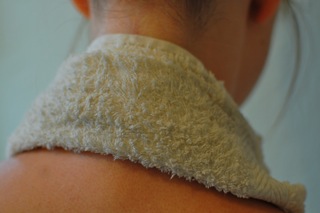
- A compress of hot thyme tea is useful laid over the lung area for coughs, colds and other respiratory problems where there is phlegm and congestion.
- A chamomile tea compress on the stomach may soothe nervous digestion. If the digestion is sluggish, nervous or constricted it is particularly nice to apply alternating compresses of hot and cold chamomile tea across the abdomen to increase circulation and stimulate vital force. Make the tea and keep half in a flask so it stays hot, then chill the other half in the fridge. When it has chilled completely soak a flannel in the hot tea (it should be as warm is as is completely comfortable, be careful not to apply anything too hot to the skin) and apply to the abdomen for 1 minute, then soak another cloth in the cold liquid, remove the hot and apply the cold for another minute. Alternate between hot and cold 5 times each, beginning with hot and ending on cold.
- Alternating hot and cold compresses are also particularly useful for sprains to speed healing and repair. Herbs such as elder leaf, ginger, comfrey or horsetail could be of use here.
- Warm compresses of ginger tea can be useful to strengthen kidney function if laid over the lower back. Don’t do this if you are suffering from a kidney infection, though it can help to prevent them if used at other times.
- Castor oil packs. Many people have heard of castor oil packs for easing congestion and I find them very useful in practice if people have the time and inclination to do them. They are useful for easing period pains, liver stagnation and constipation when applied over the abdominal region. To do a castor oil pack you need to warm about two tablespoons of castor oil very gently in a pan then pour onto a clean, slightly damp, warm flannel. Check carefully not to overheat it as you most definitely don’t want to be applying too hot oil directly on to your skin. It should be nice and warm but quite comfortable on the skin. Apply the flannel (oil side against the skin) over the abdominal area either centrally or slightly to the right over the liver area. Wrap with cling film and cover with a towel and hot water bottle. Lie down and relax for at least an hour before removing and washing off the oil.
- Rose water and apple cider vinegar, or rose infused cider vinegar diluted in water, can be used as a compress for sunburn. Aloe vera juice is also lovely applied cool on a soft cloth.
- In the absence of fresh plant material a compress can be used in place of a poultice such as a cool calendula tea for rashes or some plantain or yarrow tincture for minor wounds.
Poultices:
Poultices use whole herbs, usually mashed up into a paste and applied onto the problem area. The simplest form of poultice is the spit poultice, made my chewing up a bit of herb and applying to the skin. Plantain can be applied this way to stings and minor wounds and yarrow is great for staunching bleeding if you cut yourself whilst out walking and need a spot of first aid. A plantain poultice is also useful for drawing out splinters and boils. You can also mash the herbs with a little water and honey in a pestle and mortar or blend then down and apply directly to the site. You can also grate the plant material, as with ginger or potato which was used traditionally as a poultice for boils. If using spicy herbs such as ginger and mustard, you need to put several layers of fine muslin cloth between them and your skin to prevent irritation. Maurice Messegue, the French herbalist who was famous for his many cures, often used only external preparations such as foot and hand baths and poultices. He writes, “the herbs can be placed in a bag of finely woven cloth before being placed on the area to be treated. Which one of these methods is chosen depends on how strong the active elements in the plant are. If it is a gently acting herb, such as cabbage, there need be no hesitation in letting it come in contact with the skin. But if it is irritant or acid, with a tendency to cause redness, then it needs a brake on its action and the skin should be protected by a cloth. This precaution must always be taken with the true revulsives such as mustard.”
If I am at home I often use dried herbs in powder form to make a poultice as this is straightforward, not too messy and can be done all year round even if there is no fresh plant material available. I mix my herbs with an equal part slippery elm powder which is healing, demulcent and drawing in its own right, then add a little warm water and honey (preferably herbal infused honey if I have some to hand) and mix into a thick paste. I then spread it over the area in question and bandage in place.


Here are some useful poultices that are easy to prepare at home:
- Cabbage. The cabbage poultice must be one of the most traditional of kitchen remedies around. Used for inflammations and swellings, particularly mastitis, it is very simple to prepare. All you do is iron a few cabbage leaves to warm them up and break them down a bit then wrap them over the offending area and secure in place. Many women with mastitis just wear the leaves inside their bras.
- Mustard. Another traditional poultice for respiratory problems, make sure the skin does not come into direct contact with the mustard, see above. The onion poultice is another variation often used for respiratory ailments though in truth, I tend to stick to thyme compresses for such issues.
- Calendula and yarrow. Great as a spit poultice or made into a paste from powdered herbs to treat minor wounds and skin rashes.
- Comfrey. Well known for its usefulness in speeding the healing of sprains, strains and broken bones, you can mash up the herb and apply directly on the site or, if it is in plaster, just apply to the area above and below the cast.
- Clay. An effective drawing poultice for splinters and infections, clay packs are popular amongst naturopaths and horse owners!
 Whispering Earth
Hello, Lucinda,
i use strong green tea compresses again sunburns. Green tea is avallaible everywhere, even when travelling far away.
And red rose tea compresses on coton pads against eyeache
LikeLike
Thanks Venezia, that’s great advice, it’s so useful to have something that you can get anywhere.
Take care.
LikeLike
Thanks for the wonderful post, Lucinda.
I just did a class on poultices and compresses and will certainly forward your post on to my students!
LikeLike
Thanks April, that would be lovely. I hope there is something useful in it.
LikeLike
Where did you do your class on poultices and compresses? I am very interested in learning this?
Thanks Wendy
LikeLike
Hi Lucinda,
I can remember my grandmother using compresses and poultices.
Having little money she would use what was available in the garden or countryside.
I have used lavender (for tension in the neck muscles). and that has to be my favourite.
Also thyme…..for exactly the reasons you explain. These are my two problem areas.
I had a beautiful cavalier king charles spaniel who had a heart problem…….this caused a cardiac cough. She would roll in my bed of thyme for around five minutes most days. Animals seem to know instinctively how to take care of themselves……..
LikeLike
Hi Cheryl, Yes animals are still so connected to their senses aren’t they, there is much we can learn from them. I’m hoping to do a course in zoopharmacognacy next month which is all about facilitating animals to self select remedies, it should be fascinating.
Thyme compresses saved me from a nasty chest infection a few years ago, so I am also a big fan!
LikeLike
A wonderful and very informative article! I remember reading Messegue several years back and being absolutely astounded by his successes treating externally. I often forget how profound making these simple external preparations can be – and I just learned this lesson yet again in trying to treat a rash on my hand. I had tried making all sorts of creams, salves, essential oil blends – you name it. Nothing was making it budge. Then one day, I tried a simple chamomile compress and wallah! It went away within 2 or 3 days. Anyways, thanks for the inspiration and all the great ideas you’ve shared!
XOXO D
PS: Zoopharmacognacy sounds so fascinating!
LikeLike
Hi Danielle, Yes I have had exactly the same experience with chamomile poultices for a rash on my legs. I had also tried many different things but it was chamomile that did the trick. To me chamomile is a much overlooked super-herb, useful for so many things.
The foot and hand bath approach is so interesting isn’t it, it just shows how sensitive and absorbent these parts of our body are.
xxxxx
LikeLike
Wow, now that does sound fascinating. Hopefully you will do some posts on the subject. I, for one, would be extremely interested.
LikeLike
I remember as a child helping my mom make a sunlight soap and sugar poultice when Dad had a boil on his leg.. does that sound right?
LikeLike
I have heard of sugar and soap poultices for drawing things like boils and splinters but I have never used one myself. Did it work?
LikeLike
Nice job. Thanks.
LikeLike
Again.Thank so much for sharing.
LikeLike
Fabulous info 🙂
LikeLike
My mom has an herb garden but we never tried anything like this when I was a kid(that i can remember).
I was car accident about a month ago and I bashed my knees into the dashboard badly. My doctor thinks I have swelling in the ligaments/muscles behind my knee and is still testing that. I was wondering is you knew of any compresses that help with muscle/ligament swelling.
I’m really interested in the lavender tea compress. I have migraines since I was 18 months old. One of the best things I have ever tried for them is Badger Balm headache soother, it melts the migraine away.
I thought about what cheryl said about her king charles spaniel rolling in the thyme interesting. Could kids had that sense too? I remember as a kid there were things I either loved or hated. I loved the smell of green apples, eucalyptus, peppermint and lavender. All of those smells can help migraines. I hated cigarette smoke, perfume that wasn’t a smell I loved, the smell of cheese and aspartame in food. I couldn’t eat aspartame, it would make me sick to my stomach. The things I hated were horrible for my migraines.
LikeLike
Hi Emily.
I definitely think that we still have that sense of what is good for us and what isn’t, it’s just that we have shut down much of our intuition. Animals are known for their abilities to self-select medicines in the wild, it is makes a fascinating study to read up on, it’s known as zoopharmacognasy and I have been meaning to write a post about it for a while.
You could try a simple comfrey poultice to help to heal your knee. It would work as a compress too if you made a nice strong tea.
I hope it heals well.
LikeLike
My 11 year old get severe neck and back pain… Any advice?
LikeLike
Do you know what is causing the pain? It could be worth seeing a cranial osteopath or someone similar to check everything is in proper alignment. A nice compress would help ease the pain but you definitely need to address the underlying cause. In the short term something soothing like lavender could help with tension or something warming like ginger might help ease the pain.
LikeLike
does anyone know of a poulstice/other that has worked for vitilago?
LikeLike
In mid-Sept while doing seemingly innocuous and easy labor, I somehow pulled my back, IT Band which connects to the groin muscle, both sides of the knee and in particular from hip bone to knee along the IT band of my left leg. There were hard under the skin bumps from hip to knee along the IT band. It hit me like a sledgehammer and I ended up on my knees bent over in agony. Literally excruciating. I made my first mistake trying to do stretches with my leg. Really bad move. I made it worse. Second mistake, walking on it. It took me two weeks of lots of drugs and supposed pain relieving balms and patches with little to no relief. I even had to get a cane to Llow me to get to the bath and bed. The pain was so bad I barely slept. One day my mother said a friend ate prepared mustard daily. I was not prepared to eat a teaspoon a day. Ugh. But I tried anyway. Upset stomach! I researched online the benefits of mustard and ran across an article on preparing a mustard poultice to be applied warm to the affected area. I said why not! So I made it. One part ground mustard to 3 parts flour. Add water for a smooth paste. Not too thick but not drippy. I applied it to my leg and covered it with a hot wet towel while sitting on a stool in the tub. I then went to bed. It was magic! And my leg felt better. I was also standing almost upright. I actually slept 5 hours that night. Next day I applied it differently. I used part of an old tshirt fabric and saturated it in a soupier mixture of the same combination. Then I heated it in the microwave. I then applied it in the bathtub again. The heat helps the mustard seep deeper into the muscle. I did this 4/x a day until I could walk without pain. 3 days. I will always use this remedy for back and leg pain again and again. It was amazing. I still have some leg pain but I’m told walking on a messed up IT Band is bad news for recovery. But I do have a life and have to get around on my own. I just take it easy and baby that leg like crazy. THANK YOU MUSTARD. The miracle pain reliever.
LikeLike
Thank you for sharing your experience. That is great to hear. 🙂
LikeLike
My wife and I make green clay Poultices and Compresses for our skin and I also have edible clay so when she told me to visit this site I was and am pleasantly educated. Thanx for your wisdom and I wish you all a beaut and happy day! ;0)
LikeLike
Thank you Adrian. I hope you have a wonderful day too. 🙂
LikeLike
Has anyone ever used poultices to help with healing muscle tears? i would be very interested in this? Thank you,
LikeLike
Hey there, my Shih Tzu puppy has an abscess on her back. It started as a cyst, but is now started to erupt. The vet saw her today and said to apply a poultice mix on it. But, I am not confused as to which one I should use. Can anyone advise me what to use? My poor puppy! 😦
LikeLike
Did the vet not give you a recipe? I would ring them and ask for more details. A simple green clay and slippery elm poultice might help in the meantime – just mix the two powders with a little warm water and apply over the area. Good luck.
LikeLike
Interesting experiences… It’s all about what works. Too often pharmaceutical products don’t work. Has anyone had any good results using compresses or poultices on bulging varicose leg veins?
LikeLike
A comfrey poultice on a stubbed toe. Stubbed toe really bad right before bed. Went out and cut some comfrey leaves, made a poultice, put all around toe, wrapped toe in gauze, went to bed. No bruise and could walk with my shoe on the next day! It’s great to know how to plant, grow and use your outdoor medicine cabinet!
LikeLike
Hi, I have a horse with arthritis in his hocks, I would like to try the herbal route before steroid injections could you please recommend a poultice or compress that may help. Many thanks
LikeLike
I’m looking for something that I can use either a Compress or poultice for my Labrador whose two back feet are hurt she bent both middle nails they are swollen and infected I’ve been doing Compresses of hydrogen peroxide and epsom salts but I’m looking for other options as well perhaps a poultice in between her Epson treatments
LikeLike
Hello! I am wondering about poultices, I don’t know much at all about herbal remedies and am beginning to learn more! I am mostly interested as I am a writer of fantasy stories and wanted to get my knowledge as accurate as possible! I am wondering – after the poultice has been applied to the wound, do you have leave it like that, open to the air for a certain time, or is it possible/safe to apply a bandage over the poultice? (Specifically yarrow). Thank you!
LikeLike
Thank you for your help and knowledge on this subject of powerful healing poultices. I am not as intimidated by the process of preparing and applying a poultice.
Blessings and love.
LikeLike
Anyone know of a compress or poultice to relieve itchy bumpy skin rash? It comes and goes all over my body. The doctors call it “nonspecific dermatitis”, which I translate as “there’s something wrong with your skin.” They just prescribe Hydrocortisone cream and tell me not to scratch. Any ideas?
LikeLike
You really need to see a herbalist so they can have a look at it and find the root cause of what’s going on. It could be fungal or a number of other things. A poultice of green clay with powdered chamomile or calendula herb could help you but best to get someone to look at it if you have a practitioner near by.
LikeLike
I’ve not had dermatitis, but my skin feels itchy. Castor oil rubbed in and around my belly. Then I add a drop of melaleuca (tea tree) in my belly before bed. Then cut of all sugar. Check your gut health.
.
LikeLike