Recently I read these words from the famous and well respected nature writer Richard Mabey on the subject of the Elder (Sambucus nigra). “It is hard to understand how this mangey, short-lived, opportunistic and foul smelling shrub was once regarded as one of the most magically powerful of plants.” Now, I like Mabey and own several of his books but reading this made me seriously re-evaluate my position! She may not be a classic beauty, but look closely and you will see so many aspects of the Elder Mother to love and cherish. Her presence in the hedgerow is such a blessing. She shelters and protects not only her human children, but is also beloved of wildlife and has a key role to play in plant ecosystems as well. She is truly a mother to us all and should be treated with respect, if not veneration, by everyone whose life has been touched by her generosity.

The Elder bathed in late summer sun
Along with other white blossomed trees such as Hawthorn and Rowan, the Elder belongs to the realm of the faeries and the Goddess. I loved discovering this, as all three have been particular favourites of mine for many years. The Elder represents the old crone aspect of the goddess, as her name suggests, that part of us which is wise, experienced, strong and connected to the world of the unconscious. Part of these associations come from Celtic mythology in which Elder governed the thirteenth and final month of the year. Her place was to guard the gates between life and death, endings and beginnings, the knowledge of the day and the mysteries of the night. Her mythology has always related to those in-between times such as Samhain (Halloween) and Midsummers Eve when you would see the Faery King ride by with his retinue, should you choose to take shelter beneath an Elder tree. Elderberries gathered at Samhain are seen as especially potent medicinally, though there are seldom any left by late October.

Elder Hedgerow
Often, when I come across Elder out walking I have a sense that I’ve strayed into the path of someone venerable and wise and feel I should offer a little curtsey or bow of respect, or at least an acknowledgement in words or in thought. She seems to cooly observe the world, somewhat detached from its folly yet uncompromising in her efforts to help. Just like any loving and aged Grandmother, or anyone connected with the realms of faery, she also has a bit of a sense of humour! There’s often a challenge involved in picking Elder, she’s usually surrounded by a guard of nettles or a hidden ditch for the unwary to stumble down.

Elder Tree
In his highly recommended book The Lost Language of Plants, Stephen Harrod Buhner describes Elder as a keystone plant, one that helps to establish a community of plants by increasing the health of an ecosystem and making it more hospitable. He says;
“Keystone species, once established, call to them not only soil bacteria and mycelia but the plants they have formed close interdependencies with over millennia. As the plants arrive, the keystone’s chemistries literally inform and shape their community structure and behaviours. The capacity of keystone species to ‘teach’ their plant communities how to act was widely recognised in indigenous and folk taxonomies. Elder trees for example are keystone species in many ecosystems. Among many indigenous and folk peoples it is said that the Elder tree ‘teaches the plants what to do and how to grow,’ and that without its presence the local plant community will become confused.”
This confirms for me one of the key aspects of my understanding of the Elder, that of protection. Not only does she protect and shelter young and newly establishing species of plants but, through the berries she produces in abundance each year, she protects our immune systems during the harshest months of winter. These berries are also rich in antioxidants which are known to protect our cardiovascular system, skin and brain among other things. In folklore, The Elder was thought to protect from witchcraft and negative energies and was traditionally planted at the back of the house, whilst Rowan was planted at the front.

The Elder Protects
For me the Elder speaks of the wisdom of change, the subtle understandings of life and death and the knowledge teamed with deep compassion that only those of great age can possess. We have much to learn from this ‘mangey’ and ‘opportunistic’ old crone. This spirit of the hedgerow who doesn’t quite belong to this world, but fulfils so many duties within it.
Who cares what Mabey thinks. We love you Elder Mother.
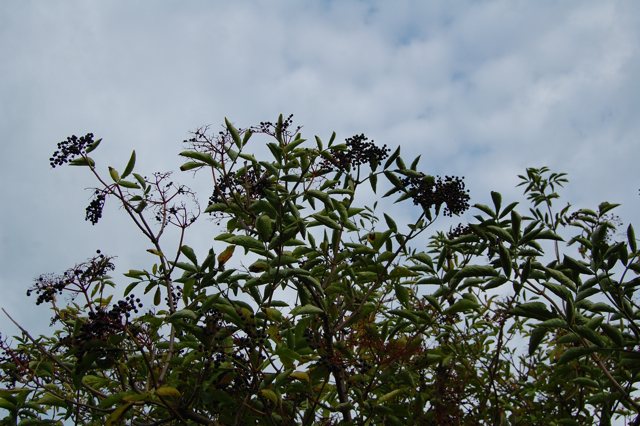
Elder Sky
Pop back tomorrow when I’ll be posting a variety of the elderberry recipes I’ve made over the last fortnight.


wow! what lovley writing lucinda! you write so beautifully!!!! the eldermother is one of natures delights no matter what anyone sais!!
yes i really want to come down to brighton to meet you! is the shop where you work full time? is your new home still near brighton? i really want to meet you we have so much in common! xxxxx
LikeLike
Hey honey,
I’m at the shop Mondays, Tuesdays and Fridays. Are any of those suitable or do you work in the week? It’s probably easiest if email you and then we can swap numbers 🙂 x
LikeLike
What Lovely post Lucinda!
I just gifted my friend with a small elder for her birthday.
She just purchased her own land and I keep the ancient custom to plant an elder as first plant before moving into a house.
Elder the protector and wise woman of trees… how beautiful she is.
LikeLike
Oh how wonderful! I often dream of planting an elder in the centre of my herb garden when I one day have some of my own land. I have heard that herbalists should be buried under an elder when they die… what a lovely idea 🙂 xx
LikeLike