In spite, or perhaps because of, it’s ubiquity at this time of year, Ground Ivy is a herb that has fallen out of fashion in these modern times when the more exotic a herb is, the greater its value is esteemed to be. Many of the older herbals speak highly of it however and it certainly earned its place in folk medicine for the treatment of a variety of ailments. Glechoma hederacea, as is its official title, was also known as ale-hoof due to its uses in brewing ale, or gill-go-by-the-ground, from the French, guiller, to ferment.
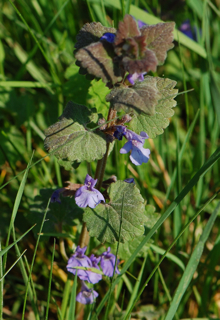
Gerard, writing in the late sixteenth century, described it thus, “Ground Ivy is a low or base herb; it creeps and spreads along the ground hither and thither, all about, with many stalks of uncertain length, slender, and like those of the Vine, something cornered and something reddish.” He classed it as hot and dry and recommended its use primarily for tinnitus, eye problems and as a cleansing agent. He gives us this lovely description of a remedy for the eyes, “Ground Ivy, Celandine and Daisies, of each a like quantity, stamped and strained, and a little sugar and Rose water put thereto, and dropped with a feather into the eyes, takes away all manner of inflammation, spots, webs, itch, smarting, or any grief whatsoever in the eyes.”

Here in the South Downs, as in much of the UK, it certainly grows ‘hither and thither’ and is looking beautiful at this time of year with its classic mint family hooded flowers adorning every roadside and path. April/ May is the best time to harvest the areal parts whilst it is in full flower and highly aromatic. The taste is very pungent, hence why it is generally considered heating and drying, though other herbalists have called it cooling, primarily due to its bitter and cleansing properties. Hilda Leyel informs us that it was once so popular and so widely on offer as a blood tonic “that it was one of the London street cries.” She also recommends it for tinnitus as well as for coughs and colds.
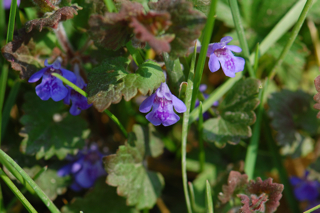
Hildegard von Bingen believed that it removed bad humours from the head which closely relates to its most common use today. Colds, catarrh, sinusitis and bronchial congestion are all conditions currently still treated with Ground Ivy. It is a mild expectorant with anti-catarrhal and anti-inflammatory qualities making it useful in some cases of hay fever. It contains many of the constituents common in other Lamiaceae, or mint family, plants such volatile oils and triterpenes which are thought to be anti-inflammatory. Its astringent and anti-inflammatory properties might also help to explain why it was found to be useful for eye problems and its anti-catarrahal nature could explain why it helped certain cases of tinnitus, probably those where congestion was a factor.

Ground Ivy also has a good reputation as a valuable tonic for the kidneys and bladder. Bartram says it is supportive to primary treatment in kidney disease and has been used with success for cancer of the bladder, though he gives no more information than this. It certainly has diuretic properties and has been used in the past to treat cystitis. Mrs Grieves writes, “As a medicine useful in pulmonary complaints, where a tonic for the kidneys is required, it would appear to possess peculiar suitability, and is well adapted to all kidney complaints.” This is particularly interesting as in both Traditional Chinese Medicine (TCM) and Iridology there can be an important link between these organs. In TCM the Lungs are said to direct Qi from the breath down to the Kidneys which then hold the Qi. If the Kidneys are compromised and unable to fulfil this function properly it will result in chest congestion and trouble breathing. Ground Ivy therefore sounds like an ideal herb in such a case.

Finally, many herbalists have recommended its use as an astringent and anti-inflammatory for the G.I. tract where it tones and soothes in cases of gastritis, haemorrhoids, IBS and diarrhoea.
A tincture can easily be made via the folk method which involves filling a jar with freshly picked and chopped plants- leaves and flowers- then covering in vodka and leaving to steep for a fortnight before straining out the plant material.

References:
John Gerard – Gerard’s Herbal
Mrs C.F. Leyel – Herbal Delights
Mrs Grieve – A Modern Herbal
Thomas Bartram – Bartram’s Encyclopedia of Herbal Medicine
Gabrielle Hatfeild – Hatfield’s Herbal
Tobyn, Denham and Whitelegg – The Western Herbal Tradition
 Whispering Earth
You have introduced me to yet another wonderful herb that I haven’t yet used, and that I am now very inspired to try! I especially love the connection you’ve pointed out between lung and kidney function – a very important point. How silly we are to become so enamoured with the exotics when the weeds in our back yards offer so much!
XOXO D
LikeLike
I agree, I like to approach medicine in the same way I approach food- mostly local, sustainable ingredients with the exotics just for spicing things up or for recipes and formulas where you just couldn’t do with out them. There are certainly some I rely on for certain issues but I think we have forgotten so many of our wonderful native pants in our quest for exciting new discoveries.
Fashions come and go but local weeds stay (and stay and stay and stay :))
xxx
LikeLike
Here, here Lucinda 🙂 Love the fact you cite so many old uses for this herb, I strongly believe that we’re losing lots of our old single herb remedies in favour of imported and exotic ones, not that I have anything against them, but I do think we need to look at our herbal heritage and what grows on our doorsteps more, that’s why mother nature put it there to help make us well with what we have to hand.
My mission is to rediscover as many of the old remedies and herbs as possible (the old books come into their own here) and put that information ‘out there’. The more I look at plants, the more I discover something I didn’t know, it’s wonderful and exciting.
Ground Ivy is something I only use occasionally for tea, they’re a little bitter for me, but I do add the leaves to salads.
Herby hugs – Debs xxx
LikeLike
Oh nice, I haven’t used them much as an edible before. Are they best when very young (like most wild greens)?
I agree that it’s so important to rediscover our herbal heritage before it’s all forgotten. An important mission indeed!!
Lots of love xxx
LikeLike
Timely I am reading this, as the gardens are just loaded with ground ivy! I have read many references in my herb books to these uses and seeing you are tincturing by the folk method urges me to go ahead and do the same, instead of just reading about it! lol big hugs dear one xx
LikeLike